All-on-4 Dental Implants Roanoke, VA
 All-on-4® dental implants in Roanoke, VA hold a full arch of teeth on four implants instead of the six or eight a full arch used to take, and the trick is the angle rather than the count. Our surgeons at Mountain State Oral and Facial Surgery tilt the two back implants so they land in dense bone the straight-up approach would have missed entirely. All-on-4® dental implants in Roanoke, VA hold a full arch of teeth on four implants instead of the six or eight a full arch used to take, and the trick is the angle rather than the count. Our surgeons at Mountain State Oral and Facial Surgery tilt the two back implants so they land in dense bone the straight-up approach would have missed entirely.
That tilt is the whole idea. Angling the back implants does two jobs at once: it reaches solid bone in front of the sinus up top and in front of the nerve down below, and it pushes the four anchor points far enough apart to carry a full arch without a graft under most of them. Fewer implants, bone you already have, and often no grafting.
All-on-4 answers how the arch is held up. It doesn’t answer when you get teeth, which is a separate question that Same Day Smile in Roanoke takes on. The two ride together often enough that patients assume they’re one product, and they aren’t. This page stays on the four implants and the geometry underneath them. Both fall under dental implants in Roanoke, handled from the Franklin Road Roanoke office.
On This Page
How Four Implants Hold a Full Arch
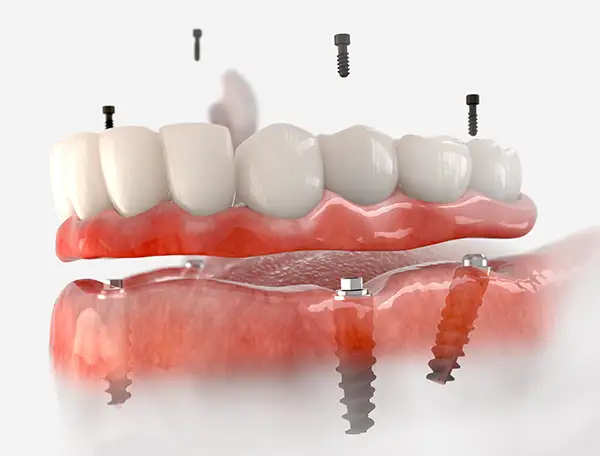 Two implants go in at the front of the jaw, straight up and down, where the bone is thickest and nothing is in the way. The other two go in at the back, tilted forward at roughly thirty to forty-five degrees. Those two are the interesting ones. A vertical implant back there would run into your sinus in the upper jaw or your nerve canal in the lower, which is exactly why the old answer was to graft bone in first and wait months for it to take. Two implants go in at the front of the jaw, straight up and down, where the bone is thickest and nothing is in the way. The other two go in at the back, tilted forward at roughly thirty to forty-five degrees. Those two are the interesting ones. A vertical implant back there would run into your sinus in the upper jaw or your nerve canal in the lower, which is exactly why the old answer was to graft bone in first and wait months for it to take.
Tilting solves that by going around the obstacle instead of through it. The implant enters at an angle, travels through bone that was already there, and comes out where a back tooth needs to sit. It also ends up longer than a vertical implant could be in the same spot, which means more surface bonded to bone. Then the arch bolts onto all four at once, and the two front implants and the two tilted ones brace against each other as a single unit rather than four separate posts.
Four implants doing the work of eight is the part that makes people skeptical, and it should. The protocol dates to the late 1990s, and tilted posterior implants have been tracked in the literature ever since. The short version: they survive at rates comparable to straight ones. The angle was the innovation, and it held up.
Where the Angle Runs Out
Tilting buys a lot of room, and it does not buy unlimited room. Three situations push a case off the standard four.
- Bone too thin even for a tilt – when the ridge has resorbed past what an angled implant can catch, bone grafting comes first and the arch comes later
- An upper jaw with nothing left – severe maxillary loss can rule out conventional implants at any angle, which is where zygomatic dental implants anchor into the cheekbone instead
- A bite that would overload four – heavy grinders and some bite patterns get five or six implants rather than four, because the design is a starting point, not a rule
Anyone promising you four implants and no graft before looking at a scan is guessing. We would rather tell you at the consultation that your case needs a graft than discover it with you sedated.
Your Roanoke All-on-4 Surgeons
Angled placement leaves less margin than vertical placement. The geometry is unforgiving: small differences at the head of a tilted implant compound along its length, so the plan has to be followed precisely rather than approximately. That is why the protocol belongs with surgeons who work in this anatomy constantly rather than occasionally, and why we navigate it live instead of freehand.
Board certification from the American Board of Oral and Maxillofacial Surgery is held by several of the surgeons here, and the current roster is on Meet Our Doctors. Placing implants at an angle, close to structures that matter, is core specialty work rather than a skill added on later.
Planning and Placing the Four
Everything starts with a 3D Cone Beam scan, and on an All-on-4 case that scan is doing more than checking whether you have enough bone. It is where we find the corridor. Your sinus floor sits somewhere, your nerve canal runs somewhere, and the space between them and the outside of your jaw is where four implants have to fit at angles that also happen to put teeth in the right place. We work that out on the scan, weeks ahead, not in the chair.
Sedation comes next, and IV sedation is what most All-on-4 patients here choose. You breathe on your own and respond to us, and afterward the appointment is simply missing. Full general anesthesia is a different pathway, hospital-based in our practice, and it seldom comes up for a case built like this one. Our anesthesia options cover the range.
Placement is where the plan meets your jaw, and where X-Guide guided implant placement earns its keep. X-Guide tracks the drill against your scan live, the way a car navigation system tracks your position against a map, so we can see the angle we are actually achieving instead of the angle we intended. On a straight implant with room to spare, that is a nice-to-have. On a tilted implant threading past a nerve, it is the difference between the plan and a surprise.
Once the four are in, we measure how tightly each one grips. That reading decides whether an arch goes on the same day or whether we let the implants integrate bare for a few months first. Neither answer is a failure. One of them is just faster.
What the Angle Buys You
The four-implant design is not about doing less. It is about doing the same job with less of your body involved, and most of what patients like about it follows from that.
| • |
Often no graft, and months you get back - Reaching existing bone at an angle skips the graft-and-wait cycle for many patients, though that is your scan’s call to make
|
| • |
Four sites healing instead of eight - Every implant is a wound. Halving the count halves the swelling, the healing, and the number of places something can go wrong
|
| • |
A shorter time in the chair - Fewer implant sites means a shorter appointment, which matters more than it sounds when the whole thing happens under one sedation
|
| • |
Enough spread to load early - Pushing the back implants further back is what creates the footprint an arch needs to be stable on day one, which is why All-on-4 and same-day treatment travel together so often
|
| • |
A design with a track record - Two decades of published follow-up sit behind four tilted implants, which counts for something when you are deciding what goes into your jaw |
It is also worth saying what All-on-4 is not. It is not the only way to hold a full arch. Multiple tooth replacement with implants using six or eight posts is still the right answer for some jaws and some bites, and implant-supported dentures in Roanoke trade the fixed arch for something you take out and clean more easily. We fit the design to the jaw rather than the other way around.
What the Arch Asks of You
A fixed arch does not come out, which means you cannot rinse it in the sink, and cleaning under it becomes the job. A water flosser under the arch, daily, is the whole routine for most patients, plus the same brushing you already do. Skip it and the tissue around the implants gets inflamed, and inflamed tissue around an implant is how good cases turn into repairs. We also unscrew the arch periodically, clean everything underneath properly, look at the implants, and put it back. That is scheduled maintenance, not a repair, and it is one of the quiet advantages of an arch that is screwed down rather than cemented. Cleaning and those check-ins are the two things you control, and between them they account for most of implant longevity.
Why Roanoke Patients Choose Us
 All-on-4 is a technique, and techniques travel. What does not travel is what happens when the case turns out to be something other than a textbook All-on-4. A ridge that looked adequate on a panoramic film and is not. A sinus that sits lower than expected. An upper jaw that needs zygomatic anchorage. Full-scope oral and maxillofacial surgery means those turns get handled here instead of turning into a referral and a new waiting list, and our dental technology covers the imaging and navigation the turns depend on. All-on-4 is a technique, and techniques travel. What does not travel is what happens when the case turns out to be something other than a textbook All-on-4. A ridge that looked adequate on a panoramic film and is not. A sinus that sits lower than expected. An upper jaw that needs zygomatic anchorage. Full-scope oral and maxillofacial surgery means those turns get handled here instead of turning into a referral and a new waiting list, and our dental technology covers the imaging and navigation the turns depend on.
The other half is that the case does not change hands at the halfway mark. Our surgeons place the implants and our team restores them, which matters because the surgical plan and the prosthetic plan are one plan. Where an implant goes is decided partly by where a tooth has to end up, and that is a far easier conversation to have inside a single practice.
All-on-4 Cost and Financing
An All-on-4 arch is a serious expense, and we would rather say that plainly than bury it. What we cannot do is print a figure here, because it is assembled from your particulars: the implant count your jaw turns out to need, whether bone work joins the plan, the material you pick for the final, and one jaw against two. The spread is wide enough that any number on this page would mislead almost everyone reading it.
People call and ask for a figure before the scan, which is a reasonable thing to want and still impossible to answer honestly. The scan determines the implant count, and the implant count is most of the figure. Anything quoted before the imaging is a guess wearing a price tag, and guesses move once reality shows up. Our financial and insurance information sets out which plans we file, and we can put you on a payment plan. Our Roanoke number is (540) 283-4940, and one visit covers both the scan and the estimate.
Book Your Roanoke All-on-4 Consultation
The only way to know whether four implants will work in your jaw is to look at your bone. Call (540) 283-4940 to get that scan on the books, or request an appointment online instead. Find us at 1603 Franklin Rd SW, Roanoke, VA 24016. Doors open at 8:00, Monday through Thursday until 4:00 and Friday until 2:30.
Frequently Asked Questions
Why four implants and not six or eight?
Because four in the right positions outwork six in the wrong ones. The count was never the point; the spread was. Two implants at the front and two angled at the back cover the same footprint six vertical implants would cover, and they do it in bone you already have instead of bone we would have to build first. Four is also a starting point rather than a rule. All on 4 dental implants as a protocol is more flexible than the name suggests, and we place five or six when your bite or your bone calls for it.
Are tilted implants weaker than straight ones?
No, and the research on this has been consistent for years. The worry is intuitive, because an angled post looks like it ought to be at a mechanical disadvantage. In practice, the failures that do turn up in the literature correlate with bone quality and hygiene rather than with angle, and long-term survival for tilted posterior implants tracks closely with straight ones. Where the angle genuinely matters is precision at the moment of placement, which is a surgical problem rather than a flaw in the design.
Can I get All-on-4 if I still have some teeth left?
Yes, and most All-on-4 patients arrive with teeth still in place. They are usually teeth that can’t be saved: loose from advanced gum disease, broken off at the gumline, or propping up a bridge that has given out. We take out what is left and place the implants in the same appointment, because extracting first and waiting just lets the bone shrink before we use it. If your remaining teeth are healthy, All-on-4 is the wrong conversation and we will tell you that.
How many teeth are on an All-on-4 arch?
Usually ten to twelve per arch, running back to about the first molar. That surprises people expecting a full count of fourteen. The second molars sit at the very back of the jaw where bite force is highest and support is thinnest, and hanging teeth out that far past the last implant creates leverage that works against the whole arch. Functionally you lose very little, because most chewing already happens forward of that point.
Does All-on-4 work as well in the upper jaw as the lower?
It works in both, and the lower jaw is the easier one. Lower bone is denser, so implants grip harder at placement and immediate loading clears the bar more often. The upper jaw is softer bone with a sinus sitting in the middle of it, which means upper cases lean harder on the tilt and more often need an extra implant, a graft, or anchorage into the cheekbone when the loss is severe. Plenty of patients treat one arch. Plenty treat both.
How is this different from an implant for every tooth?
Bone, time, and cost all argue against one-for-one. Replacing fourteen teeth with fourteen implants would take more bone than most people have left after losing a full arch, plus more appointments, more healing, and far more money. Single tooth replacement with implants is the right approach when you are missing one tooth in an otherwise healthy mouth. Once the whole arch is gone, individual implants stop making sense and a shared arch on four anchors starts to.
Do the angled implants make the teeth look tilted?
No. The angle lives entirely below the gumline, in the bone, where nobody will ever see it. Angled abutments sit on top of the tilted implants and correct the direction, so the arch that screws down lands exactly where teeth belong. From the outside an All-on-4 arch looks like an arch. The geometry doing the work is invisible once the tissue heals over it.
Can the arch be replaced later without redoing the implants?
Yes, and that separation is deliberate. The implants and the arch are different components with different lifespans. The implants fuse into your jaw and, kept clean, tend to stay put. The arch is the wearing part, and when it eventually needs replacing we unscrew the old one and fit a new one onto the same four implants. Patients often assume a problem with the teeth means starting over on the surgery. It almost never does.
|