Bone Grafting Roanoke, VA
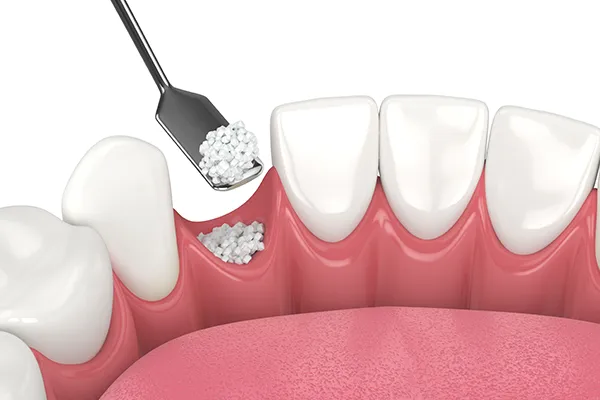 Bone grafting rebuilds jawbone that has been lost, and it is the treatment that turns “you do not have enough bone for implants” into a plan, which is why Mountain State Oral and Facial Surgery performs its own grafting at our Roanoke, VA office. If somebody has already told you implants are off the table, that assessment was probably accurate about your bone today. It says nothing about your bone in six months. Bone grafting rebuilds jawbone that has been lost, and it is the treatment that turns “you do not have enough bone for implants” into a plan, which is why Mountain State Oral and Facial Surgery performs its own grafting at our Roanoke, VA office. If somebody has already told you implants are off the table, that assessment was probably accurate about your bone today. It says nothing about your bone in six months.
Most patients arrive at grafting sideways. You went in asking about dental implants, a scan came back thin, and suddenly there is a second procedure and a longer timeline between you and the teeth you wanted. That is a real disappointment, and we are not going to pretend the wait is nothing. But grafting is not a consolation prize or a workaround. It is the step that makes everything after it hold.
Our surgeons graft, place implants, and restore them inside one practice, so a thin scan does not turn into a referral out and a wait to be seen somewhere else. Bone grafting runs the same way at every one of our offices, Roanoke included.
On This Page
What a Dental Bone Graft Is
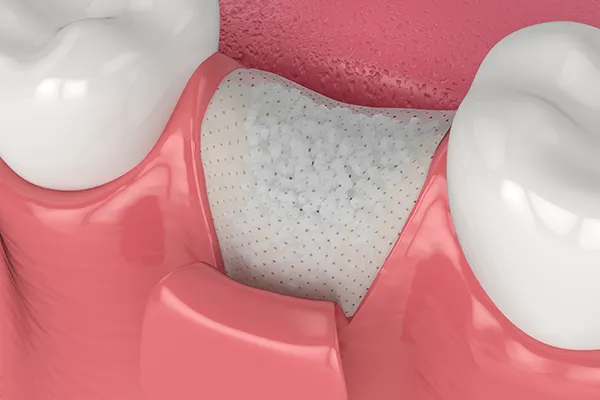 A bone graft is a scaffold. We place granular material into the area where bone is missing, cover it with a membrane so gum tissue cannot grow into the space, and your own body does the rest. Over several months your cells migrate into that scaffold, lay down living bone, and replace the graft material as they go. What you end up with is your bone, not a permanent implant of somebody else’s. A bone graft is a scaffold. We place granular material into the area where bone is missing, cover it with a membrane so gum tissue cannot grow into the space, and your own body does the rest. Over several months your cells migrate into that scaffold, lay down living bone, and replace the graft material as they go. What you end up with is your bone, not a permanent implant of somebody else’s.
That distinction matters because patients often picture a graft as a block of foreign material screwed into the jaw. For the great majority of the grafting we do, it is closer to filling a pothole with material that the road then turns into asphalt.
Why Your Jaw Loses Bone in the First Place
Jawbone exists to hold teeth. It is maintained by the force of chewing traveling down a root into the bone around it, and when the root leaves, that signal stops. The body reads unused bone as surplus and reclaims the minerals. The steepest losses happen in the first year after an extraction, and the ridge keeps narrowing for years after that, which is the mechanism we lay out in missing teeth and bone loss.
Denture wearers lose bone faster still, because a plate presses down on the ridge from above without loading it the way a root would. This is why someone who has worn a lower denture for fifteen years often has very little ridge left to work with.
Where the Graft Material Comes From
Most of what we place is processed donor bone from a tissue bank, sterilized and stripped of its cells. It is a mineral scaffold rather than living tissue, which is why it does not carry the rejection risk patients worry about. Bovine-sourced and synthetic mineral options work the same way. Occasionally we harvest a small amount of your own bone from elsewhere in the jaw when a case calls for it.
We also use platelet rich plasma on many grafts. We draw your blood at the appointment, spin it down, and concentrate the platelets and growth factors that drive healing, then mix that concentrate into the graft site. It comes from you, which is the whole point.
Socket Preservation, at the Time of an Extraction
The least expensive graft is the one that happens the day the tooth comes out. Socket preservation puts material into the empty socket immediately, before the ridge has a chance to collapse inward. It adds a few minutes to an appointment you are already having, and it can remove the need for a larger graft later. If you are scheduled for an extraction and implants are anywhere in your thinking, ask about this before the tooth comes out rather than after.
Sinus Lift, for the Upper Back Jaw
Your maxillary sinuses sit directly above your upper molars, and when those teeth go, the sinus floor tends to drop down into the space they left. A sinus lift raises that floor and packs graft material underneath it to build the height an implant needs. It carries a longer recovery than most grafts and a set of cautions specific to the sinus, which we go through at the consultation.
Ridge Augmentation, for Width and Height
Sometimes there is enough bone vertically but the ridge has gone knife-edge thin, or a long-empty area has lost shape in both directions. Ridge augmentation rebuilds the contour so an implant has bone on all sides of it rather than just underneath.
Which one you need is a scan question, not a guess, and plenty of cases need more than one.
Your Bone Grafting Surgical Team in Roanoke
Our surgeons include board-certified oral and maxillofacial surgeons, several of them certified by the American Board of Oral and Maxillofacial Surgery, and the current roster is on Meet Our Doctors. Grafting is where that training earns its keep, because the decision is rarely whether to graft. It is which graft, how much, and whether the site can take an implant at the same visit or needs to heal first.
The structural advantage here is that our surgeons graft, place, and restore. A practice that only places implants has to send you elsewhere when the scan comes back thin, and the graft gets planned by someone who will not be placing the implant that goes into it. Here, the person deciding how much bone to build is the person who has to put an implant into it in six months. That tends to focus the mind.
Grafting also sits inside a full-scope oral and maxillofacial practice rather than a standalone implant clinic. Extractions, sinus work, and the anesthesia to get through any of it comfortably are all in-house, which matters because grafting cases have a habit of arriving attached to something else.
The Grafting Process, Step by Step
The honest headline is that grafting adds months before implant placement, not weeks. Anyone telling you otherwise is selling something. Here is where the time actually goes.
Cone Beam Scan and the Decision
We scan with 3D Cone Beam imaging, which measures bone height, width, and density in three dimensions. A flat X-ray cannot see width at all, which is why patients are sometimes told they have plenty of bone and then told otherwise. You leave this visit knowing which graft you need, whether it can happen alongside an extraction, and the real timeline.
The Grafting Appointment
Most grafts take under an hour. We open the site, place the material, often mix in platelet rich plasma from a blood draw taken that morning, cover it with a membrane, and close. Your comfort is decided beforehand from our anesthesia options: local, nitrous oxide, or IV sedation. Exparel, a non-opioid anesthetic, can hold the site numb long past the drive home.
The First Two Weeks
Swelling peaks around day two or three and then falls off. Soft food, no smoking, and no poking at the site with your tongue, which is harder advice to follow than it sounds. A little graft granule working its way loose in the first days is normal and is not the graft failing.
Three to Six Months of Nothing Happening
This is the part patients hate, and it is the part that cannot be shortened. Your cells are migrating into the scaffold and turning it into bone, and the timeline belongs to your biology rather than our schedule. Larger grafts and sinus lifts sit at the longer end. Placing an implant into a graft that has not matured is the single most reliable way to lose both.
Re-Scan, Then the Implant
We scan again before committing. If the bone is there, we place. If it is not quite there, we wait rather than gamble, and occasionally a site needs a second, smaller graft. Once the implant goes in, recovery follows what we publish for post-operative implant care.
What Bone Grafting Makes Possible
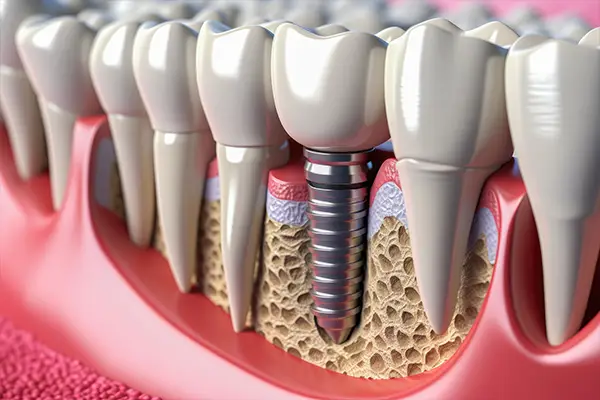 Grafting is not the goal. It is what stands between you and the goal, and the value is entirely in what it unlocks. Grafting is not the goal. It is what stands between you and the goal, and the value is entirely in what it unlocks.
The Implant Option Comes Back
This is the whole point. A no from a general dentist usually means the bone is thin today and that office does not graft. Since our surgeons do, the same scan that closed the door somewhere else opens a route here. That includes routes other practices do not have: for severe upper loss we also place zygomatic dental implants, which anchor into the cheekbone and skip the missing ridge entirely.
Your Face Keeps Its Shape
Lower-face height depends on the ridge underneath it. When bone disappears, the chin rotates forward, the lips lose support, and people read the result as aging rather than tooth loss. Grafting preserves the architecture. It is also why timing matters more than patients expect: the ridge you still have is far easier to keep than to rebuild.
You Are Not Managing the Case Yourself
The graft, the implant, and the restoration all sit with one surgical team, on one set of records, at our Roanoke office on Franklin Road. Nobody hands you a disc of scans and a phone number. That sounds like a small thing until you have spent three months as the go-between while your ridge keeps narrowing.
The Timeline Is the Cost, Not the Risk
Grafting is slow, but it is not fragile. A graft that underperforms almost always produces less bone than planned rather than none at all, and a smaller second procedure closes that gap. What the months buy you is a site solid enough to still be holding an implant decades from now. How well any given graft takes depends on your healing, your smoking status, and how much bone we were trying to rebuild, and no surgeon can honestly promise a result in advance.
Why Choose Our Roanoke Office for Bone Grafting
Grafting is not a service most practices are set up to run. It needs 3D imaging to plan, an operating environment to place, sedation to get through comfortably, and a surgeon who will still be responsible for the site when an implant goes into it months later. Our surgeons run the full scope of oral and maxillofacial surgery and do their own grafting, so all four pieces sit in the same practice.
The imaging is the part you can check. Deciding how much bone a site needs is a measurement, and our 3D cone beam and digital imaging produce it before anyone quotes you a plan. Our Roanoke office at 1603 Franklin Rd SW is part of a practice with offices across West Virginia, Kentucky and Virginia, which is why that scanner is in town rather than at a referral center. Whatever else the case turns into, whether an extraction or oral surgery in Roanoke of another kind, it stays here.
The last reason is that we will tell you when grafting is not worth it. Some sites do not need it. Some patients are better served by a shorter implant, a different position, or a treatment that skips the graft. You get that read at the consultation, before anything is scheduled.
Bone Grafting Cost and Financing
Grafting arriving as an unbudgeted extra is one of the more frustrating things that happens to patients, and we will be straight about it. It is a real additional cost on top of the implant treatment you came in for. It is also generally a small fraction of that treatment, and skipping it usually costs more later, because an implant placed into insufficient bone fails and then you are paying for the graft anyway plus a redo.
What moves your number: which graft, how many sites, whether it happens alongside an extraction you are already having, whether platelet rich plasma is part of the plan, and which anesthesia you choose. Socket preservation added to an extraction sits at the low end because you are already in the chair. A sinus lift sits at the high end.
Insurance treats grafting inconsistently, and it is one of the areas where medical coverage sometimes applies rather than dental. Our team runs both before you commit, and payment plans are laid out with coverage in our financial and insurance information.
Schedule Your Roanoke Consultation
If you have been told your jaw cannot take implants, a cone beam scan will tell you whether that is still true and what it would take to change. Call our Roanoke office at (540) 283-4940, or request an appointment online. We are at 1603 Franklin Rd SW, Roanoke, VA 24016. Roanoke hours are 8:00 to 4:00 Monday through Thursday, and 8:00 to 2:30 on Friday.
Frequently Asked Questions
Can the implant go in at the same time as the graft?
Sometimes, and it depends on how much of the socket wall survived. When enough native bone remains to hold the implant steady while the graft matures around it, we can do both at one appointment and save you months. When the defect is large or the implant would have nothing solid to grip, staging them is the only honest option. Your cone beam scan settles this, not a preference.
Is donor bone safe to put in my jaw?
Yes, and the reason is that it is not living tissue by the time it reaches you. Tissue-bank material is processed and sterilized down to a mineral scaffold, which is why it does not carry the rejection risk patients picture. Donor screening and that processing together have made disease transmission vanishingly rare, and grafting with it has been standard in oral surgery for decades. If it still bothers you, synthetic and bovine-derived options behave almost identically, and we are happy to use them.
How long after an extraction is it too late to graft?
It is almost never too late, but it does get harder and more expensive the longer you wait. The first year after an extraction takes the biggest bite out of the ridge, and what is gone is gone. A graft at ten years is still very doable; it is just a bigger graft than the one you could have had at the time of the extraction, which is the argument for socket preservation.
Will I be able to feel the graft in my jaw afterward?
No. Once the site has healed you cannot feel a graft, because what is there is your own bone. Some patients notice firmness in the gum over the site for a few weeks, and a stitch or a membrane edge can be detectable with the tongue early on. By the time the implant goes in, the area feels like the rest of your jaw.
How will I know whether the graft actually worked?
A second cone beam scan at the end of healing shows it directly, in millimeters, which is why we re-scan before placing rather than assuming. Density and volume both show up. You will not be able to tell by feel and neither could we, which is precisely why we do not skip this step in our Roanoke office.
What happens if the graft does not take?
We re-graft, usually with a smaller correction rather than starting over. Partial takes are more common than outright failures, meaning the scan shows some new bone but not enough, and a second procedure closes the gap. Smoking is the single biggest reason grafts underperform, followed by uncontrolled diabetes and an infection that was already present at the site. None of that is a promise that a graft always works; it is why we check before we place.
Does bone grafting hurt more than having a tooth pulled?
A standalone graft is generally comparable to or milder than an extraction, and a graft placed into a socket during an extraction adds almost nothing to what you would have felt anyway. Sinus lifts are the exception and bring more swelling and more pressure. Across all of them, day two or three is the peak, and Exparel keeps the site numb well past the point where most patients expect it to wear off.
Do I need a graft if I am not planning on implants?
Not necessarily, but socket preservation at the time of an extraction is worth considering even then, because it keeps the option open at very little added cost. Patients change their minds, and a ridge that held its shape gives you choices in five years that a collapsed one does not. It also gives a denture a better foundation to sit on, which is part of why we argue that dentures are not a long-term solution on their own.
|