Types of Dental Implants Roanoke, VA
 There is more than one type of dental implant, and which one you need comes down mostly to two things: how many teeth you are replacing, and how much jawbone is left to anchor them. Our surgeons place all five, so the conversation you have at Mountain State Oral and Facial Surgery in Roanoke, VA is about which one fits your jaw rather than about what happens to be on the menu. There is more than one type of dental implant, and which one you need comes down mostly to two things: how many teeth you are replacing, and how much jawbone is left to anchor them. Our surgeons place all five, so the conversation you have at Mountain State Oral and Facial Surgery in Roanoke, VA is about which one fits your jaw rather than about what happens to be on the menu.
Most people who land here have already made the big decision. They want implants. What they can’t work out is which kind. The types of dental implants worth knowing about come down to five, and most patients fit one of the first three without much debate.
Still weighing whether implants are the right route at all? Start with dental implants in Roanoke instead. What follows picks up after that decision is made.
On This Page
Start With How Many Teeth You Are Replacing
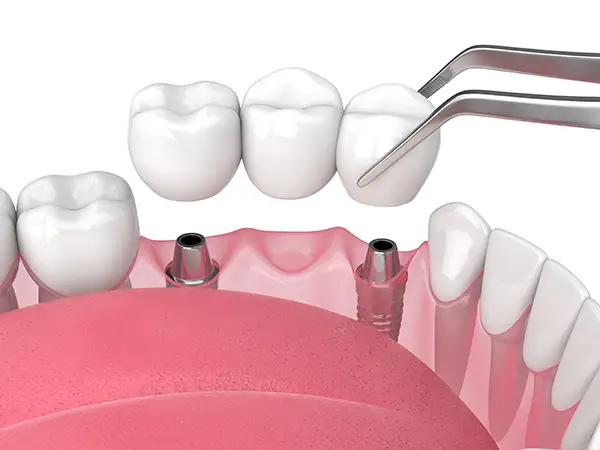 Almost every implant decision starts with a count. One missing tooth, a gap of two or three, and an arch that is failing all at once are three different problems, and they get three different answers. Almost every implant decision starts with a count. One missing tooth, a gap of two or three, and an arch that is failing all at once are three different problems, and they get three different answers.
One Missing Tooth
A single implant replaces one tooth on its own. We place a titanium post in the jaw where the root used to be, let it fuse to the bone over several months, then attach a crown to it. Nothing is done to the healthy teeth on either side, which is the main reason our surgeons favor this over a traditional bridge when the neighbors are sound. More on how that works on single tooth replacement with implants.
Several Teeth in a Row
Missing two, three, or four teeth next to each other does not mean an implant per tooth. Two implants can carry a bridge across the gap, which means fewer surgical sites, less healing, and less hardware in your jaw than replacing each tooth on its own post. The trade is that the teeth in the middle of that bridge are supported at the ends rather than underneath, so the span has a practical limit. Where that limit falls for you is a bone question, and it is covered on multiple tooth replacement with implants.
A Full Upper or Lower Arch
When a whole arch is gone or going, the count stops mattering and the anchoring starts. A full arch of replacement teeth rides on four to six implants, not one per tooth, because the implants are foundations rather than substitutes. The best known version of this is All-on-4 in Roanoke, which angles the back implants to catch bone that is still solid and often avoids grafting entirely.
From there the question is fixed or removable. A fixed arch stays in your mouth and you clean around it like teeth. Implant supported dentures in Roanoke snap onto the implants and come out at night, which some patients prefer and which changes what the day of surgery looks like. If the part you care about is walking out with teeth rather than a gap, that is a timing question, and Same Day Smile in Roanoke is where it gets answered.
When a Standard Implant Will Not Fit
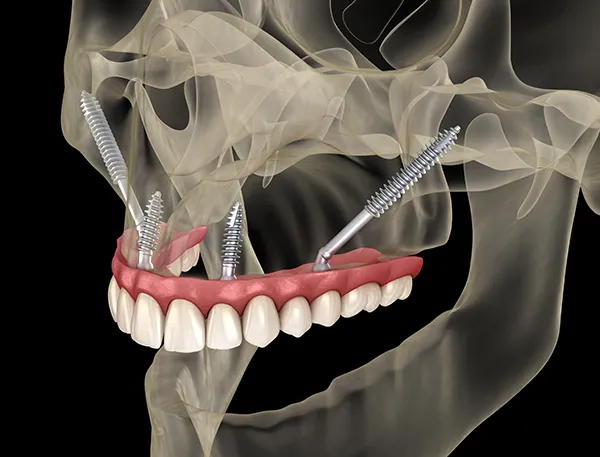 Standard implants need bone to sit in, and bone leaves once teeth do. If you have been without teeth for years, or you have worn an upper denture for a long time, there may not be enough left in the places a standard post wants to go. That’s not the end of the conversation. It’s where the last two types come in. Standard implants need bone to sit in, and bone leaves once teeth do. If you have been without teeth for years, or you have worn an upper denture for a long time, there may not be enough left in the places a standard post wants to go. That’s not the end of the conversation. It’s where the last two types come in.
Zygomatic Implants for Severe Upper Jaw Bone Loss
Zygomatic implants are longer, and instead of anchoring in the upper jaw they anchor in the cheekbone, which almost never resorbs. That sidesteps the missing bone rather than rebuilding it, and it is why patients who were told they would need many months of grafting before implants were possible sometimes have a faster route available. They apply to the upper arch only.
Mini Implants for Narrow Ridges
Mini dental implants solve the opposite shape of problem. Where a ridge has gone thin rather than short, a standard post is too wide for the bone that is there, and a narrower one fits without building the ridge up first. Minis are the usual answer for stabilizing a lower denture that will not stay put. They are a different tool rather than a budget version of the same one, and our surgeons are deliberate about which cases they suit.
Titanium, Zirconia, and What Sits on Top
Most implants are titanium and have been for decades, because titanium fuses to living bone in a way very few materials do. Zirconia is the newer alternative and is made in one piece rather than two, which means the post and the abutment are a single unit instead of separate parts that screw together.
That one difference drives most of the rest. A two-piece titanium implant gives us more room to adjust the angle of what sits on top of it, which matters when the bone points one way and your bite points another. Neither material is the automatic right answer. If you want the full comparison before your consultation, our surgeons lay it out on dental implant materials.
Your Implant Team in Roanoke
Our surgeons include board-certified oral and maxillofacial surgeons, several of them certified by the American Board of Oral and Maxillofacial Surgery. On a decision like this one that credential does specific work, because the person telling you which type you need is the same person who places it and the same person who sees you again if it does not go to plan.
Choosing between implant types is a judgment call rather than a lookup. It rests on how much bone you have and where, how your bite loads that part of the mouth, and what you want to be chewing in ten years. Making that call honestly takes a surgeon who places all five types often enough to have no favorite among them. Their training and board certifications are public. Full roster on Meet Our Doctors.
How We Land on the Right Type for You
The count narrows it to two or three options in about a minute. Everything after that is bone, and bone is the part nobody can eyeball.
| 1. |
We take a 3D Cone Beam scan - It shows the height and width of your bone in three dimensions, plus exactly where your sinus and the nerve in your lower jaw sit. A flat X-ray flattens all of that into a guess.
|
| 2. |
We look at what is still working - Healthy teeth next to a gap change the answer. So does an opposing arch that is fully restored, because it decides how hard your bite will land on whatever we place.
|
| 3. |
We name the type and the reason - You should leave able to repeat back not just which type, but why that one and not the next one over. If we can’t explain the why in plain language, the plan isn’t finished.
|
| 4. |
We plan the placement before we place it - Once the type is settled, the scan becomes the map. X-Guide guided implant placement lets our surgeons follow that map during placement rather than working from memory of it. |
Two things worth knowing about that sequence. The scan comes before the recommendation, not after, which is the whole point. And the recommendation is not final until you have heard it, because you are the one who has to live with how it eats. If you want the broader picture of how our surgeons approach dental implants across the practice, that is the place to start.
Why Getting the Type Right Matters
The point of sorting the type out properly is that a matched implant disappears from your life. You stop thinking about it. That sounds like a small thing until you’ve spent a year thinking about a tooth.
A type that fits your bone heals more predictably, because the implant is doing the job it was shaped for instead of being asked to hold in bone that is wrong for it. A type that fits your bite lasts longer, since chewing load lands where the design expects it. And a type that fits your life is the one you will actually maintain, which over ten years matters more than the metal does.
The reverse is the part worth naming plainly. A standard post forced into a ridge that is too thin can fail, and a failed implant costs you the implant, the healing, and often bone you did not have to spare. Getting the type right the first time is cheaper than getting it wrong once, in every sense of the word.
Why Roanoke Patients Choose Our Surgeons
The honest reason to care where you have this conversation is that the answer depends on data plenty of offices do not gather before naming a plan. A 3D Cone Beam scan shows bone height and width in three dimensions and shows where the sinus and nerve sit. A flat film does not. Without that scan, “you need a graft” and “you are fine” are both opinions.
Our surgeons place every type covered here rather than referring the harder ones elsewhere. That matters less as a claim about scope than as a claim about honesty, because a practice that does not place zygomatic implants will rarely conclude that you need them. Being able to say yes to all five is what makes it possible to say no to four of them for a real reason.
Roanoke is one of eleven offices across West Virginia, Kentucky, and Virginia, and there is one surgical roster behind all of them rather than a different bench at every address. What that means for you is practical rather than sentimental. You don’t have to drive to a bigger city to start the harder version of this conversation.
What Each Type Costs and Why It Varies
Cost is often the second question and sometimes the first, and asking it early is fair. You won’t get a runaround on it here. There are no numbers on this page because the number moves with which type you need, how many implants it takes, whether bone has to be built first, what the restoration on top is made of, and what your plan covers. Any figure printed here would be wrong for most people reading it.
The shape of it we can give you. More implants cost more than fewer. A full arch costs more than a single tooth. Grafting adds a procedure and months to the timeline, so an approach that skips the graft can change the total even when the implant itself is not the cheaper part. That is the main reason the type conversation and the money conversation happen at the same visit rather than weeks apart.
Coverage varies more between plans than patients expect, and our team will check your specific benefits rather than estimate them. Details on insurance, financing, and payment options, including payment plans for the portion a plan does not cover. Call the Roanoke office at (540) 283-4940 and we will run your benefits before you decide anything.
Schedule Your Implant Consultation in Roanoke
Bring the questions and let us bring the scan. Call our Roanoke office at (540) 283-4940 to book a consultation. Our Roanoke office is at 1603 Franklin Rd SW, Roanoke, VA 24016. The office is open Monday through Thursday from 8:00 to 4:00, and Fridays until 2:30. You can also request an appointment online if that is easier.
Frequently Asked Questions
How do I know which type of dental implant I need?
You will not know for certain until someone reads a 3D scan of your jaw, and that is not a stall. The count of missing teeth narrows it to two or three candidates in about a minute. What separates those candidates is bone height and width, which can’t be seen from the outside or from a flat X-ray. Come in expecting to leave with the answer rather than to bring one.
Are mini dental implants as good as regular implants?
In the right ridge, yes. The narrow diameter is a feature rather than a compromise, since it lets the implant sit in bone that would otherwise have to be built up first. Where minis are the wrong call is a lone molar carrying heavy chewing load, because the same narrowness that rescues a thin ridge leaves less surface to spread that force across. That is a case-by-case read rather than a rule against minis.
I was told I do not have enough bone for implants. Do I have options?
Often yes, and it is worth a second look before you accept a no. Severe upper jaw bone loss is the exact problem zygomatic implants were designed for, since they anchor in the cheekbone and skip the bone that is missing rather than rebuilding it. A thin lower ridge is a different problem and usually routes toward minis or grafting. A no from an office that does not place zygomatic implants is a no about that office.
How many implants does it take to replace a full arch of teeth?
Four to six for most people. The number is set by bone quality and by which jaw, since upper bone is generally softer than lower and sometimes asks for a fifth or sixth anchor to spread the load. All-on-4 in Roanoke is the four-implant version of this, and it is not automatically the right one. A surgeon who reaches for four in soft bone every time is following a brand rather than a scan.
Does the type of implant change how long it lasts?
Less than most people assume. The bigger variables are how well the implant fused in the first place, how your bite loads it, and whether the gums around it stay healthy. A well-placed mini in a good candidate will outlast a poorly planned standard implant. Our surgeons go deeper into this on the longevity of dental implants.
Would I have to go to Charleston for the less common implant types?
Start in Roanoke either way, and ask this at your consultation rather than assuming an answer. Our surgeons place all five types, so nothing gets ruled out for you because a type is off the menu. The practice runs eleven offices across three states, so if any stage of your treatment is better done at another one, that is worth confirming while the plan is being made rather than after.
Does the type of implant affect the cost?
Yes, and not always in the direction people expect. A full arch on four implants can land under the cost of replacing six individual teeth one at a time, because you are paying for anchors rather than for teeth. Ask for the numbers on your specific plan once the type is settled, since that is the first point at which any figure means anything.
What if I change my mind about the type after we start?
It depends where you are in the process. Before placement the plan is fully open and changing it costs you a conversation. Once the posts are in the bone the anchors are set, though what goes on top of them has more flexibility than patients assume. This is why the type question is worth settling deliberately rather than in the last five minutes of a consultation.
|