All-on-4 Dental Implants Lynchburg, VA
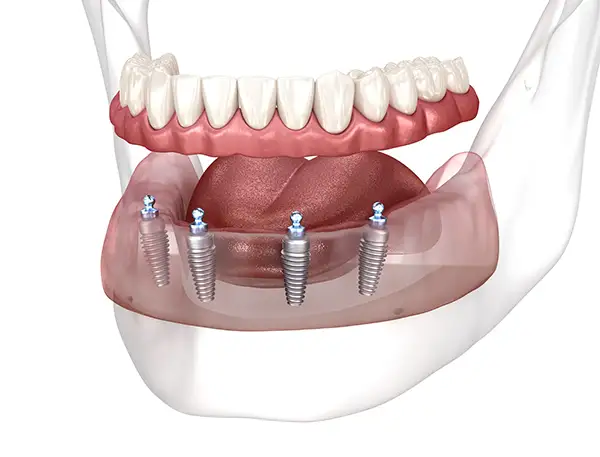 All-on-4® dental implants in Lynchburg, VA anchor a complete arch of teeth to four titanium posts: two set vertically at the front of the jaw, two tilted backward at an angle. That angle isn’t a shortcut. It is what makes a full arch possible for Mountain State Oral and Facial Surgery on the bone you have left, without spending months growing more of it first. All-on-4® dental implants in Lynchburg, VA anchor a complete arch of teeth to four titanium posts: two set vertically at the front of the jaw, two tilted backward at an angle. That angle isn’t a shortcut. It is what makes a full arch possible for Mountain State Oral and Facial Surgery on the bone you have left, without spending months growing more of it first.
Read that as a claim about engineering rather than speed. All-on-4 describes how an arch gets held up: where the implants sit, which way they point, and how a bite on your back tooth finds its way down into your jaw. Whether you leave with teeth on the day of surgery is a separate question with a separate answer, and Same Day Smile in Lynchburg is where that one gets settled. Most patients want both. They are still two decisions.
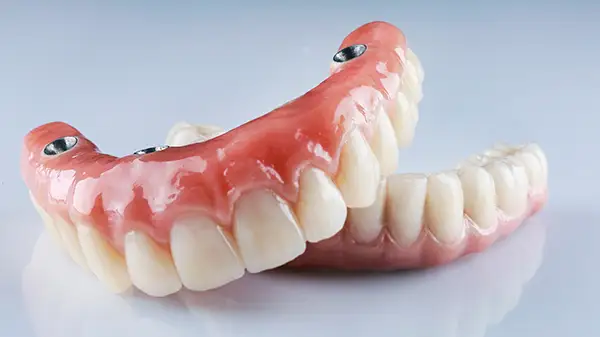
One thing worth settling early: this is not a plate that clips onto implants. The arch is bolted down and stays down, and you clean around it rather than taking it out at night. That single distinction shapes daily life more than any other feature of the treatment, and it is the fork where some patients choose implant-supported dentures in Lynchburg instead. Every one of these routes counts as dental implants in Lynchburg in the end, worked out of Graves Mill Road at the Lynchburg office.
On This Page
The Four-Implant Protocol
 The front of your jaw is the part you can count on, and that is where the protocol starts. Even in a mouth that has lost everything, the bone between the two eye-tooth positions usually survives in reasonable shape, while further back the ridge has thinned and left a sinus above or a nerve below with very little clearance to spare. So the two front implants go in vertically, where the bone is, and the two back implants tilt forward to stay inside that same reliable zone while still reaching back far enough to carry the chewing end of the arch. The front of your jaw is the part you can count on, and that is where the protocol starts. Even in a mouth that has lost everything, the bone between the two eye-tooth positions usually survives in reasonable shape, while further back the ridge has thinned and left a sinus above or a nerve below with very little clearance to spare. So the two front implants go in vertically, where the bone is, and the two back implants tilt forward to stay inside that same reliable zone while still reaching back far enough to carry the chewing end of the arch.
The alternative used to be to build the missing bone up and wait for it, which works but adds months and a second surgery. Angling around the problem arrives at the same destination using what is already there, and it collects a bonus on the way: a post driven at a slant covers more distance inside the jaw than one driven straight down, so more of its surface ends up gripping. All on 4 dental implants were designed around exactly that trade. When the loss is severe enough that even a tilt finds nothing, the case moves to grafting or to zygomatic dental implants reaching into the cheekbone, and no honest plan rules that out before the scan.
What the Arch Is Made Of
You end up with two arches over the course of treatment, and they are not the same object.
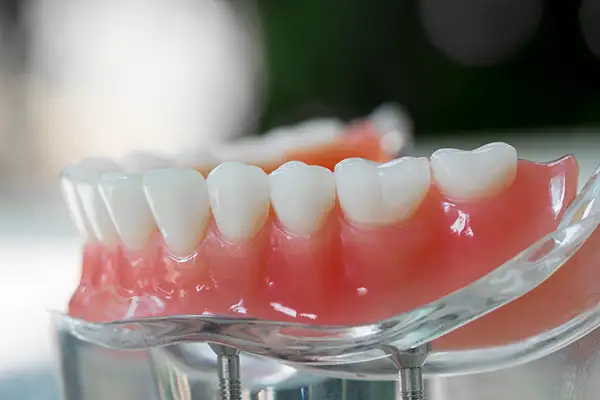
- The provisional – acrylic, usually reinforced with a metal bar, worn while the implants fuse. Being adjustable is the point of it, because your bite and your gum line both move during healing and this arch has to move with them
- An acrylic and titanium final – acrylic teeth on a milled titanium frame. Lighter, straightforward to repair, and the teeth wear gradually over years the way real ones do
- A zirconia final – milled from a single block of ceramic. Harder, resists staining, and does not wear down, though it is less forgiving when something does go wrong
Neither final material wins outright. Zirconia suits heavy chewers and anyone who wants the arch looking identical in fifteen years. Acrylic on titanium suits patients who value easy repair and a slightly softer bite. We settle that choice with you before the final is designed rather than after, and dental implant materials covers what each one is at the material level.
Your Lynchburg All-on-4 Surgeons
The tolerance on a tilted implant is tighter than on a vertical one, in a specific way: a small difference in angle where the implant enters compounds into a meaningful one by the far end. Vertical implants in generous bone forgive a lot. This one forgives less, which is the argument for putting it in the hands of people who spend their week inside this anatomy rather than visiting it occasionally, working from a plan and live navigation rather than judgment alone.
Several of the surgeons here carry board certification from the American Board of Oral and Maxillofacial Surgery, and you can read their backgrounds on Meet Our Doctors. The training is a hospital-based residency running years past dental school, built around exactly the combination a full-arch case demands: sedation, surgical extraction, bone, and the rebuild that follows.
Reading the Bone, Placing the Four
A panoramic X-ray flattens your jaw into two dimensions and tells us roughly what is there. That is not enough to plan an angled implant. The 3D Cone Beam scan we take at your consultation returns the jaw as a volume instead of a silhouette: how tall the bone stands, how wide it runs, how dense it is, and precisely where a sinus floor or a nerve canal crosses the line a tilted implant would follow. Every decision in this treatment traces back to that one file.
What has to be true is easy to state and impossible to promise in advance: enough bone, running the right direction, for a long implant to pass through and surface where a tooth belongs. Sometimes there is room to spare. Sometimes it is tight enough that we plan five implants instead of four. Sometimes the scan says bone grafting has to come first, and finding that out weeks ahead beats finding it out with you already sedated.
Placement runs under IV sedation for most patients: breathing on your own, responsive to us, no memory of it afterward. The general anesthesia route exists, but our practice runs it hospital-side, and it is almost never the answer for treatment like this at Graves Mill Road. Our anesthesia options lay out where each one applies.
The implants go in using X-Guide guided implant placement, which puts the live position of the drill on a screen against your scan while we work. A vertical implant with room around it tolerates a small drift. A tilted implant running past a nerve canal does not, and watching the real angle develop as it happens is how the plan and the outcome end up matching.
Your First Year, Provisional to Final
The provisional goes on either the day of surgery or a few months after it, depending entirely on how firmly the implants grip when we place them. From there you eat soft while bone grows onto the titanium, and we space follow-up visits through that stretch to make sure nothing is drifting. Once the implants are integrated we take a completely fresh set of records, because your gums have reshaped themselves since surgery and the final arch has to fit the mouth you have now, not the one you had in the chair. The final typically goes on somewhere between six and twelve months from the start. After that, the appointments become ordinary maintenance.
Why the Design Holds Up
Four separate posts in a jaw would be a fragile arrangement. Four posts locked together by one rigid arch is a different structure entirely, and that difference does most of the work here. Once the arch is bolted across all four, no implant works alone. Force arriving anywhere on the arch travels through the frame and gets shared out into four separate stretches of bone rather than being absorbed at a single point. Cross-arch stabilization is the term for it, and it is why a design that sounds under-built performs the way it does.
The tilt supplies the other half. Angling the back implants pushes the rear anchor points further back than a vertical implant could reach, which shortens the stretch of arch hanging unsupported off the end. Less overhang means less leverage working against the implants every time you chew. It is a shelf bracket: move the support outward and the shelf stops sagging.
Under all of it sits osseointegration, where your own bone grows directly onto the titanium until the two behave as a single material. That fusion is the difference between an implant and a peg in a hole, and it is also the reason the timeline has a floor. Bone grows at the speed bone grows, and no technique argues with that.
None of this makes four implants right for every jaw. It makes them right for most jaws, which is a narrower claim and a more honest one.
Why Lynchburg Patients Choose Us
 Full-arch implant treatment is increasingly offered by practices that do full-arch implant treatment and nothing else, and there is a genuine argument for that kind of focus. The argument for the other approach shows up on the day a case stops being a straightforward full-arch case and turns into a bone problem, a sinus problem, or an anatomy problem. This practice does the whole range of oral and maxillofacial surgery, so All-on-4 is one of the things it does rather than the only thing, and every alternative route is available in the same building. Our dental technology carries the imaging and navigation those routes depend on. Full-arch implant treatment is increasingly offered by practices that do full-arch implant treatment and nothing else, and there is a genuine argument for that kind of focus. The argument for the other approach shows up on the day a case stops being a straightforward full-arch case and turns into a bone problem, a sinus problem, or an anatomy problem. This practice does the whole range of oral and maxillofacial surgery, so All-on-4 is one of the things it does rather than the only thing, and every alternative route is available in the same building. Our dental technology carries the imaging and navigation those routes depend on.
We also place and restore. That reads like an administrative footnote right until month four, when your bite needs a small adjustment and the person making it is the person who chose where the implants went. The continuity isn’t glamorous. It just deletes an entire category of delay.
All-on-4 Cost and Financing
No number on this page, and not out of cageyness. An All-on-4 case gets priced against your jaw, and jaws vary: how many implants yours turns out to need, whether grafting joins the plan, one arch or two, and which final material you choose. That last one moves the figure more than patients expect, which is part of why we talk materials before we talk totals.
Insurance rarely covers a full arch outright, though it usually covers more of the component parts than patients assume. Which parts, and under which policy, comes down to your plan and to whether a given step reads as dental or as medical. Our team sorts that out and files it. Which plans we work with is on our financial and insurance information page, and financing is available. Our Lynchburg number is (434) 316-7111, and what comes back is a price for your case rather than for a category.
Book Your Lynchburg All-on-4 Consultation
Nobody can tell you over the phone whether you are an All-on-4 case. The scan can. Book the scan at (434) 316-7111, or request an appointment online if that suits you better. The office sits at 1612 Graves Mill Road, Lynchburg, VA 24502. Weekdays, 8:00 to 5:00.
Frequently Asked Questions
Is All-on-4 a brand name or a technique?
Both, which is where the confusion begins. All-on-4 is a registered trademark, developed by Nobel Biocare, and it also describes a specific surgical arrangement: four implants, the back two tilted, carrying one arch. Other manufacturers sell their own four-implant systems under their own names, and the underlying geometry is broadly similar. What decides your case is whether that arrangement suits your anatomy, which is a question your scan answers and a brand name does not.
Can the implants be felt, or set off airport scanners?
No to both. The implants sit down inside your jawbone under healed gum tissue, and there is nothing to feel once integration is finished. Airport scanners don’t react to them either, because the amount of metal is small and titanium isn’t magnetic. For the same reason titanium implants are MRI-safe, which turns out to matter far more often in real life than the airport question does.
What if I lose one of the four implants years from now?
We check whether the remaining implants can carry the arch while a replacement integrates, and frequently they can. Late failures are uncommon, and when they do happen the cause is usually peri-implantitis, an infection in the tissue around the implant driven by what didn’t get cleaned, rather than the implant wearing out. That is why the post-operative implant instructions aren’t a formality. The arch itself normally stays in service through the repair.
Does the arch stain over time?
That depends on the material, and it is one of the real differences between the two finals. Zirconia is glass-hard and essentially non-porous, so coffee, tea, and red wine sit on the surface and brush off. Acrylic is more porous and will pick up color gradually over years, the way a denture does, though polishing recovers most of it. Neither material responds to whitening, which is worth knowing before you pick a shade. The color you choose is the color you keep.
Why two arches? Why not make the final one first?
Because your mouth is going to change shape, and a final arch can’t chase it. Removing teeth and placing implants sets off months of remodeling in the gum and bone underneath, settling into a contour that simply doesn’t exist yet on surgery day. An arch milled to fit day-one anatomy would fit poorly by month four, with gaps beneath it that trap food. The provisional carries you through the reshaping and gets adjusted while it happens. Then we record the mouth you actually ended up with.
Can I have All-on-4 if I have osteoporosis?
Often yes, and the diagnosis matters less than the medication. Osteoporosis on its own has a weaker link to implant failure than most people assume, and survival rates hold up reasonably well. What genuinely changes the picture is the drug class: bisphosphonates and related bone-density medications, especially given intravenously, raise the risk of a healing complication in the jaw. Bring the real medication list, including anything you have stopped, because some of these drugs stay in bone for years after the last dose.
Do I still need a general dentist after this?
Yes, and patients are regularly surprised by that. You have no natural teeth on the treated arch, but you still have gum tissue, bone, the implants themselves, and usually an opposing arch of real teeth that needs ordinary care. You also still need oral cancer screening, which has nothing to do with having teeth. We look after the implants and the arch while your general dentist handles the rest. It is one of several assumptions our dental implant FAQ sets straight.
What if I do not like how the teeth look?
That is a large part of what the provisional is for. You wear it for months. You see it in your own mirror, in your own light, next to your own face, and you form opinions no amount of chairside discussion would have surfaced: too white, too long, not enough character, wrong shape at the corners. All of it feeds into the design of the final arch, which we build after you have lived with the first one. It is a rehearsal you would not otherwise get.
|