Dental Implants Lynchburg, VA
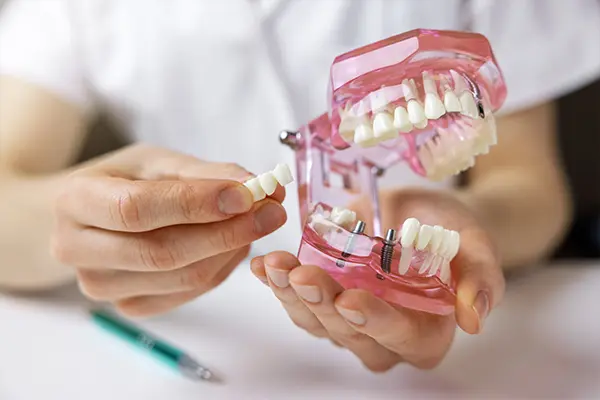 A dental implant is the only tooth replacement that goes into the jawbone instead of sitting on top of it, and that one difference is why Mountain State Oral and Facial Surgery recommends implants over bridges and dentures for most patients in Lynchburg, VA. Bone that stops carrying a tooth starts disappearing. An implant gives it something to carry again. A dental implant is the only tooth replacement that goes into the jawbone instead of sitting on top of it, and that one difference is why Mountain State Oral and Facial Surgery recommends implants over bridges and dentures for most patients in Lynchburg, VA. Bone that stops carrying a tooth starts disappearing. An implant gives it something to carry again.
Implants are the largest part of the surgical work we do, and our practice-wide dental implants section explains the treatment in general terms. This one is specific to our Lynchburg office at 1612 Graves Mill Road, open 8:00 to 5:00 Monday through Friday. Those hours run later than our West Virginia offices, which matters more than it sounds if the only appointment you can take is a late one.
If the conversation about your tooth has jumped straight from “this has to come out” to “here is a partial,” the implant option is worth raising before you decide anything. Thin bone is the usual reason people get steered away from implants, and thin bone is something we build back rather than work around.
On This Page
How a Dental Implant Replaces a Tooth
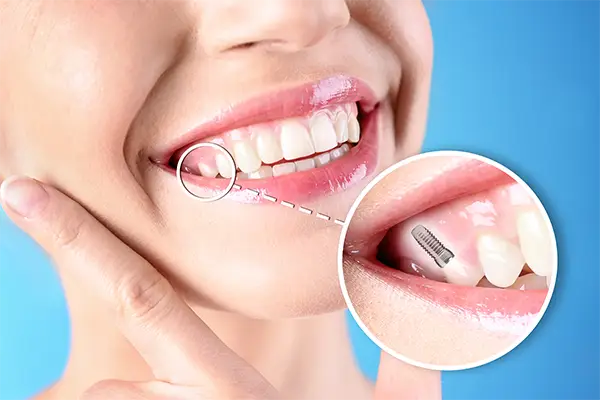 Start with what a natural tooth actually is: a root anchored in bone, and a crown above the gumline doing the chewing. Every replacement option has to answer both halves of that, and only one of them really tries. A denture replaces the crown and ignores the root. A bridge replaces the crown and borrows the roots of the teeth on either side. A dental implant replaces the root with a titanium post, then builds a new crown on top of it. Start with what a natural tooth actually is: a root anchored in bone, and a crown above the gumline doing the chewing. Every replacement option has to answer both halves of that, and only one of them really tries. A denture replaces the crown and ignores the root. A bridge replaces the crown and borrows the roots of the teeth on either side. A dental implant replaces the root with a titanium post, then builds a new crown on top of it.
Titanium earns its place because bone treats it as something to grow onto rather than something to wall off. Over three to six months the surrounding bone knits directly to the surface of the post, a process called osseointegration, and once it finishes the post is held the way a root was held. The materials used in dental implants haven’t changed much in principle since the 1960s, because the principle works.
Are You a Candidate for Dental Implants?
Most people missing a tooth are, and the honest version of that sentence comes with conditions. Bone volume is the first one: the post needs enough height and width to sit in, and where that’s short we route to bone grafting instead of routing to a partial. Gum health is the second, because implants fail around infected tissue exactly the way natural teeth do. Smoking and uncontrolled diabetes are the two that move the odds most without ruling anything out, and bisphosphonates and similar bone medications need a conversation before, not after. If you want to think it through ahead of your visit, our dental implant candidacy discussion lays out the same criteria we use in the operatory.
One Tooth, a Section, or the Whole Arch
A single tooth implant is one post and one crown, and it’s the most common case we see. Where two or three teeth are gone in a row, an implant supported bridge carries them on two posts rather than six. A full arch usually lands on All-on-4 dental implants if you want something that stays in, or implant supported dentures if you would rather have something removable that no longer slides. The scan decides which of those your bone will actually support, and that’s a fifteen-minute answer rather than a guess.
Your Oral Surgeons in Lynchburg
An oral and maxillofacial surgeon is a dentist who then completed a hospital-based surgical residency in the specialty, which is the distinction our what is an oral surgeon explainer walks through. Our roster includes board-certified oral and maxillofacial surgeons, several holding American Board of Oral and Maxillofacial Surgery credentials. Our roster covers all eleven of our offices, so the surgeon planning your case in Lynchburg comes from the same group handling implant cases across West Virginia and Kentucky. Names, degrees, and training are all under Meet Our Doctors.
Implant work sits at the center of that specialty rather than beside it. The same training that covers taking a tooth out, reading a cone beam scan, grafting a socket, and staying clear of the inferior alveolar nerve is the training that covers putting a post in. It’s also why the harder cases stay here instead of getting handed off: a sinus floor sitting too low, a ridge gone knife-edge under an old partial, an upper jaw with almost nothing left to anchor to. X-Guide Dynamic 3D Navigation covers the precision half of that. The surgeon covers the judgment half.
What the Implant Process Looks Like
Budget four to eight months from consultation to finished tooth, and longer if the site needs building first. Almost all of that is bone healing on its own schedule rather than appointments. Across the whole case, most patients sit in the chair four or five times:
| 1. |
The scan and the conversation – A 3D Cone Beam scan at the first visit shows bone height, bone width, nerve position, and sinus anatomy in one pass. You find out that day whether the site is ready or needs building first.
|
| 2. |
Grafting, if the site needs it – Where bone is short, we place graft material and let it mature for three to six months. This is the step nobody expects, and it’s also the step that turns a no into a yes.
|
| 3. |
Planning the position – We map the post against your scan before you come back in. In tight cases we place it under X-Guide Dynamic 3D Navigation, which tracks our instruments against that plan in real time instead of against a surgeon’s memory of it.
|
| 4. |
Placing the post – One appointment, usually under an hour for a single implant. You pick the anesthesia: local, nitrous oxide, or IV sedation, with Exparel afterward to hold the area numb through the evening without an opioid.
|
| 5. |
Integration – Three to six months while bone knits onto the titanium. Nothing is asked of you here beyond not smoking and not testing the temporary on anything hard.
|
| 6. |
The crown – We fit the abutment and the final restoration once the post is solid, then check the bite. Every follow-up stays with the same office that did the surgery. |
Six steps, and only two of them put you in the chair for any real length of time. Your post-operative implant instructions are written by the surgeons who placed the post rather than handed over as a generic sheet. The anesthesia decision is worth making before the consultation rather than in the moment, and our anesthesia options cover what local, nitrous oxide, and IV sedation each involve.
Why Implants Beat the Alternatives
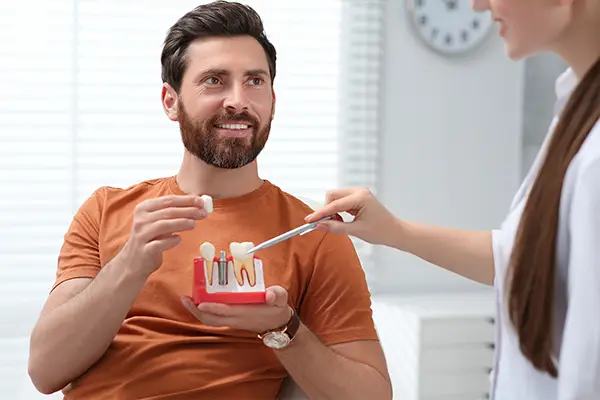 Structure is one argument. The one patients actually feel shows up at dinner and at bedtime, and it’s worth being specific about what changes. Structure is one argument. The one patients actually feel shows up at dinner and at bedtime, and it’s worth being specific about what changes.
- The jaw holds its shape – Bone under an implant keeps getting loaded, so it keeps its height and width. Bone under the false tooth of a bridge, or under a denture, doesn’t, and that steady loss is why long-term denture wearers develop a collapsed lower face. We scan at the start and again before the crown, so you can watch your own ridge hold rather than take our word for it.
- Nothing healthy gets sacrificed – No reduction of the neighboring teeth, no clasps hooked onto what’s left. Clasped teeth take load they were never built for, and if a tooth beside the gap is already struggling, we plan both at once instead of solving one and revisiting the other in two years.
- Chewing force comes back – A denture returns a fraction of natural bite force and an implant returns most of it. We register the final bite digitally with the Trios 5 scanner rather than with a tray of putty, which is why the adjustment visit is usually short or unnecessary.
- The number of posts isn’t the number of teeth – Replacing several teeth with implants rarely means one post per tooth. Four to six well-placed posts can carry a full arch, and we plan that count off the bone you have rather than the teeth you lost.
- Nothing comes out at night – Fixed restorations stay fixed. For a lot of the patients who sit down in our Lynchburg consultation room, that’s the entire reason they came in.
The honest counterweight is time. A denture can be delivered in weeks. An implant takes months, and if the site needs a graft it takes longer still. What the wait buys is a result measured in decades rather than years, and whether that trade is worth it depends on your situation more than on our opinion.
Choosing Our Lynchburg Office
Our Lynchburg office is at 1612 Graves Mill Road and stays open 8:00 to 5:00 Monday through Friday, later than our West Virginia offices close.
Lynchburg is a new market for us. We’d rather say that plainly than lean on how long we’ve been somewhere else. What came here came complete: board-certified oral and maxillofacial surgeons, 3D Cone Beam imaging for the diagnosis, X-Guide Dynamic 3D Navigation for the placement, and the Trios 5 intraoral scanner for the restoration. Three pieces of equipment, three stages of the case, nothing missing in between.
Scope is the argument that matters most in implant work. We are a full-scope oral surgery practice in Lynchburg, and the surgical procedures we handle run from extractions and grafting through jaw surgery and oral pathology. That breadth is what keeps an implant case moving on the day your scan shows something nobody planned for.
What Dental Implants Cost
Nobody can quote you a number off a web page, and anyone who does is quoting somebody else’s mouth. What we can tell you is what moves the figure: how many teeth are being replaced, whether the old tooth is still in, whether the bone needs building first, which anesthesia you pick, and whether the top is a single crown, a bridge, or a full arch. A graft adds cost and adds months. A straightforward single implant in solid bone does neither.
Insurance is where this turns frustrating, and the expectation is better set now than later. Many dental plans treat implants as their own category with a separate annual cap, some cover the extraction and the graft but stop at the post, and a few exclude implants while still covering a denture. Our team runs your specific plan before you commit to anything. The financial and insurance information covers the plans we take, and payment arrangements exist for the gap a policy leaves behind. Call (434) 316-7111 if you want that benefits check started before your consultation.
Book a Consultation in Lynchburg
One visit tells you whether an implant is realistic for your case. Call us at (434) 316-7111 to get on the schedule. If it’s easier, request an appointment online and we’ll reach out to confirm a time. Our Lynchburg office is at 1612 Graves Mill Road, Lynchburg, VA 24502.
Frequently Asked Questions
How long does the dental implant process take in Lynchburg?
Four to eight months for a straightforward case, and seven to fourteen if the site needs a bone graft first, because a graft needs a three to six month head start of its own. The reason for the spread is that bone heals on its own schedule and can’t be hurried. Chair time is a much smaller number: four or five appointments across the whole case, with the placement itself usually running under an hour for a single implant.
Are dental implants better than a bridge?
For a single gap with healthy teeth on either side, an implant is almost always the better long-term answer, because a bridge requires permanently reducing two healthy teeth to carry it. The bridge wins on speed: weeks rather than months. It loses on arithmetic, since a bridge typically needs replacing within ten to fifteen years and the two prepared teeth underneath it are now on their own clock too. Where several teeth in a row are gone, an implant supported bridge gives you the bridge without borrowing anyone’s roots.
What is a bone graft and will I need one?
A graft adds material to a spot where the jaw has thinned, then gives your body three to six months to convert it into your own bone. Roughly speaking, the longer a tooth has been gone, the likelier you need one, which is why a socket grafted at the time of extraction often skips this step entirely. Your cone beam scan answers the question in one visit rather than in stages, and bone grafting covers the variations we use.
Will I be asleep during dental implant surgery?
Most implant patients pick IV sedation. You stay responsive rather than unconscious, but the memory never forms, so the appointment registers afterward as a gap rather than an hour. Local anesthesia alone is enough for many single implants, and nitrous oxide sits between the two. The decision is yours to make at the consultation rather than ours to make for you, and nobody talks you into more than you want.
Can my own dentist make the crown?
Yes, and plenty of patients prefer that, particularly if they have seen the same dentist for years. We place the post, hand over the records and the digital scan, and your dentist builds the crown. We can also do the whole thing here, which keeps the surgical plan and the final restoration under one roof. Neither route costs you the implant. It’s a preference question, and it’s worth making deliberately rather than defaulting into.
What happens to my jaw if I just leave the gap?
The bone under the gap starts resorbing within months, and roughly half the width is gone inside the first year. That’s the part patients don’t see coming, along with the second part: the teeth on either side drift toward the space and the tooth above or below it drifts down into it, which is how one missing tooth turns into a bite problem three teeth wide. More on the mechanics under missing teeth and bone loss. Leaving a gap is a decision, not a neutral pause.
Do I need a referral to be seen for implants?
No. You can call our Lynchburg office directly and book a consultation without a referral from a general dentist. Many of our patients do arrive by referral, and we work closely with dentists and orthodontists across the Lynchburg area, but a referral is a convenience rather than a requirement. Bring any recent X-rays if you have them, and your full medication list either way.
How much time off work will I need after implant surgery?
Most patients take the rest of the day and go back the next morning after a single implant. Swelling builds for a couple of days before it turns around, so judge the week from day four if you’re in front of people. If you chose IV sedation you can’t drive yourself home, so arrange a ride before the appointment. Larger cases and grafts ask for more, and we tell you which one you are before you book the date.
|