Implant Supported Dentures Lynchburg, VA
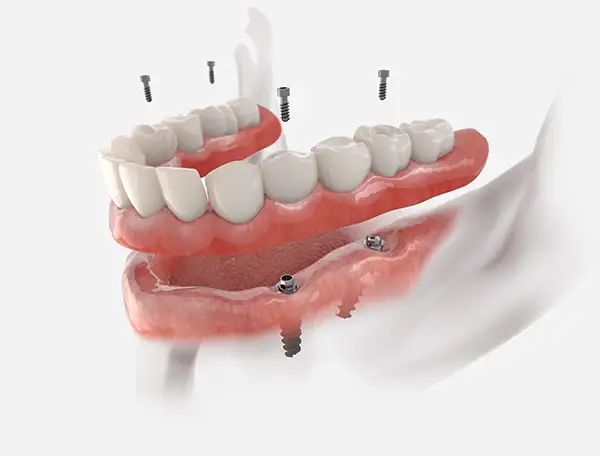 An implant supported denture replaces a full arch of teeth with a denture that snaps onto dental implants instead of resting on your gums, and Mountain State Oral and Facial Surgery places these in Lynchburg, VA at our office on Graves Mill Road. It is removable. You take it out at night, clean it, and put it back in the morning, where it locks onto the implants and stays put through the day. An implant supported denture replaces a full arch of teeth with a denture that snaps onto dental implants instead of resting on your gums, and Mountain State Oral and Facial Surgery places these in Lynchburg, VA at our office on Graves Mill Road. It is removable. You take it out at night, clean it, and put it back in the morning, where it locks onto the implants and stays put through the day.
A lot of people land here after pricing a fixed full-arch case and deciding it was out of reach. That is a reasonable place to end up, and it is not the end of the conversation. A snap-in overdenture uses fewer implants than a fixed All-on-4 arch, which is most of why it costs less. What you trade for the savings is that you handle the appliance twice a day rather than leaving it in permanently. For many patients that is a trade worth making. For some it is not, and we will say so.
Both paths are dental implant treatments, and both beat what you are living with now if you are wearing a conventional denture. The reason a plate that fit at delivery stops fitting is that the ridge underneath it keeps shrinking, and we go through the mechanism on our own look at why dentures are not a long-term solution.
On This Page
How Implant Supported Dentures Work
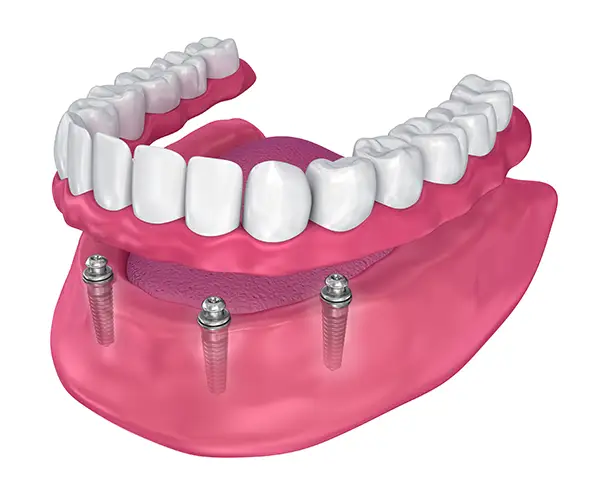 The implants go in your jaw. Attachments sit on top of them. The underside of the denture has matching sockets, and the two click together when you press the denture down. That is the entire mechanism, and it is why the appliance behaves so differently from a plate that is only held in by suction and paste. Our practice-wide implant supported dentures overview covers this treatment as we run it across every office. The implants go in your jaw. Attachments sit on top of them. The underside of the denture has matching sockets, and the two click together when you press the denture down. That is the entire mechanism, and it is why the appliance behaves so differently from a plate that is only held in by suction and paste. Our practice-wide implant supported dentures overview covers this treatment as we run it across every office.
The click is the part patients notice. You seat it in the morning and it does not move again until you decide to move it. No adhesive, no readjusting mid-sentence, no keeping track of where the denture is going to end up when you bite into something firm.
Why Your Upper and Lower Arches Are Different Problems
A lower conventional denture is the one that fails people. There is nothing down there for it to hold onto: no palate, no suction, just a narrowing ridge and a tongue that pushes it around. Two to four implants transform a lower arch more dramatically than almost anything else we do.
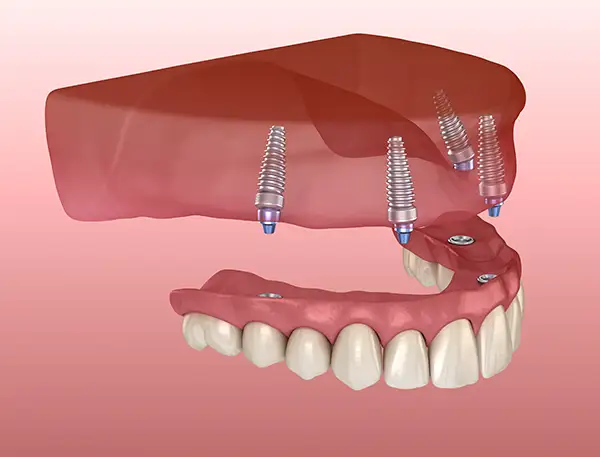
An upper conventional denture actually behaves better on its own, because the palate gives it a large surface to grip. So the upper case is usually less about stability and more about coverage. Four or more implants on top let us open up the palate, which is what brings back the taste and temperature of your food. Upper bone is also softer and the arch is longer, which is the other reason the implant count goes up.
Whether Your Jaw Has the Bone for It
This is a measurement question, and nobody can answer it by looking in your mouth. Every case here begins with a 3D Cone Beam scan that gives us bone height, width, and density in three dimensions. The good news for anyone previously turned away: an overdenture asks less of your bone than a fixed arch does, so patients who were told no for All-on-4 are sometimes yes for this.
If the scan does come back short, the fix is grafting, and our surgeons do their own. Bone grafting in Lynchburg happens in this practice, on our records, rather than as a referral out and a wait to be seen.
Your Surgical Team in Lynchburg
Our surgeons include board-certified oral and maxillofacial surgeons, several of them certified by the American Board of Oral and Maxillofacial Surgery. You can see the current roster on Meet Our Doctors. The reason that credential is worth checking on this particular treatment is that oral and maxillofacial surgery is a hospital-based residency built around anesthesia and jaw anatomy, which is the training a full-arch case leans on hardest.
That training shows up in the unglamorous parts. Deciding whether an upper arch can hold four implants or needs a sinus lift first is an anatomy call. Sedating a patient safely in an office rather than sending them to a hospital is an anesthesia call. Our practice handles both of those in-house, along with its own grafting, so a case that turns complicated does not become a chain of referrals.
It also means one team owns the whole arc. Our surgeons place the implants and restore them, which is not how every implant practice works. Plenty place and hand you back to your general dentist for the denture. When the fit is off six months later, that split is what makes it nobody’s problem to fix.
Your Treatment, Step by Step
Plan on four to eight months from the first Lynchburg appointment to a finished denture, longer if you need grafting first. Here is where that time goes.
| 1. |
Consultation and cone beam scan. We measure your bone in three dimensions and look at whatever denture you are currently wearing. You leave knowing your implant count, whether grafting comes first, and the real timeline
|
| 2. |
Grafting, only if the scan calls for it. Our surgeons graft in-house and often add platelet rich plasma from your own blood draw. Then three to six months for that bone to mature, because placing an implant into a graft that is not ready is how you get a failure at year two
|
| 3. |
Implant placement. One appointment, usually under two hours for a lower arch. You pick your comfort level in advance from our anesthesia options: local, nitrous oxide, or IV sedation, which patients call twilight and do not remember. We can add Exparel, a non-opioid anesthetic, to hold the numbness well past the drive home
|
| 4. |
Healing. Three to six months while bone grows onto the implant surface. You keep wearing your existing denture through most of it, relieved so it is not pressing on the sites underneath
|
| 5. |
Attachments and delivery. We take a digital scan with our Trios 5 scanner instead of a tray of impression material, fit the attachments, and seat your denture. You practice removing and reseating it with us before you go home |
Recovery from the placement appointment runs along the same lines we publish for post-operative implant care: soreness and swelling for a couple of days, not weeks.
Benefits of Implant Supported Dentures
 The benefits worth your money are the ones you notice on a Tuesday, not the ones that photograph well. The benefits worth your money are the ones you notice on a Tuesday, not the ones that photograph well.
The Ridge Stops Vanishing
Bone that carries no load resorbs, which is the engine behind every refit you have paid for. Implants load the bone and slow that down. This is the reason our practice pushes patients toward implants rather than another reline, and we lay the argument out in missing teeth and bone loss.
You Get the Less Expensive Option, Not a Lesser Practice
Some offices only build fixed arches, so a fixed arch is what you get recommended. We build both, which means the recommendation you hear at Graves Mill Road is driven by your cone beam scan and your budget rather than by our inventory. If your scan says a fixed arch is genuinely the better call, we will tell you that too.
Bone Loss Is a Route, Not a Refusal
Our surgeons graft, place, and restore inside one practice, and they place zygomatic implants for severe upper bone loss. Being told no somewhere else is common among the patients who end up here, and it usually means the other office did not offer grafting, not that your jaw ruled it out.
Comfort Is Decided in Advance
Nitrous, IV sedation, and Exparel are on our own anesthesia menu, not a referral to a surgery center that will schedule you in five weeks. You choose before the day, and you can change your mind at the consultation.
Why Choose Our Lynchburg Office
Full-arch cases go sideways at the handoffs. An overdenture that starts as a simple two-implant plan can turn into extractions, a graft, and a restoration, and every time one of those steps belongs to a different office you lose weeks and somebody loses the scan. Our surgeons run the full scope of oral and maxillofacial surgery, do their own grafting, and restore what they place, so those handoffs do not exist.
The equipment is the second reason, and it is a plain one. Deciding between two implants and four is a bone question with a numerical answer, and our 3D cone beam and digital imaging give it to us before you are quoted anything. Our Lynchburg office on Graves Mill Road is part of a practice with offices across West Virginia, Kentucky and Virginia, which is why that scanner is here in town rather than a drive away.
The third is that we are willing to lose the case. Some patients should graft first and revisit in six months. Some should spend more and get the fixed arch. Some have a health history that makes elective implant surgery a bad idea this year. You will hear that at the consultation rather than after a deposit.
Cost and Financing for Implant Dentures
Cost is usually the whole reason patients are reading this page instead of the All-on-4 one, so we will be direct about it. A snap-in overdenture generally costs less than a fixed same-day arch, and the reason is arithmetic rather than quality: fewer implants, less hardware, less chair time. You are not buying a lesser version of the same thing. You are buying a different design that asks less of your jaw and less of your wallet, and gives up permanence in exchange.
The variables that actually move your estimate are the implant count, whether grafting comes first, one arch or two, the anesthesia you choose, and the attachment system your bite calls for. That is why the scan comes before the number and why no honest office quotes a full-arch case over the phone.
Coverage tends to arrive in pieces. Dental plans often contribute toward the denture itself and medical plans sometimes contribute toward extractions or grafting. Our team checks both before you commit, and payment plans sit alongside coverage details in our financial and insurance information.
Schedule Your Lynchburg Consultation
If a fixed arch came back out of range, a cone beam scan will tell you what your jaw can support and what it would cost. Call our Lynchburg office at (434) 316-7111, or request an appointment online. We are at 1612 Graves Mill Road, Lynchburg, VA 24502. Our Lynchburg hours are 8:00 to 5:00, Monday through Friday.
Frequently Asked Questions
Do I have to take the denture out at night, or can I sleep in it?
Take it out. Gum tissue that stays covered around the clock gets inflamed and sore, and the attachments need brushing on both sides to stay clean. Sleeping in a snap-in denture is also the fastest way to wear out the nylon inserts. The nightly routine takes about the same two minutes you already spend on a conventional denture.
How long will I be without teeth during treatment?
You should not be without teeth at any point. If you already wear a denture, you keep wearing it through healing and we relieve the underside so it is not pressing on the implant sites. If we are extracting teeth as part of the plan, we sort out an interim denture before the extraction appointment, not after. Nobody goes home from our Lynchburg office with an empty arch and a shrug.
Can I have implants if I smoke or have diabetes?
Often yes, and neither one is an automatic disqualification. Well-controlled diabetes barely changes implant success rates, while poorly controlled diabetes slows healing enough to matter, so your recent A1c is the number we care about rather than the diagnosis. Smoking is the bigger risk factor, and cutting back around the surgical window measurably helps. We work through the specifics on whether you are a candidate for dental implants.
What happens if one of the implants does not fuse to the bone?
We remove it, let the site heal, and usually place another one, often slightly wider. Early failures show up in the first few months rather than years later, which is one reason the healing check appointments exist. It is uncommon, and it is recoverable. The biology behind why implants bond in the first place is covered in osseointegration.
Will an implant supported denture change the way I talk?
Most people speak better, not worse, because a denture that stays put stops the clicking and slipping that a loose plate causes. There is usually a short adjustment period of a week or two, especially on an upper where we have opened up the palate, and s sounds are the ones that take longest to settle. Reading aloud for ten minutes a day speeds it up more than anything else we can tell you.
Can I do just my lower arch and leave my upper denture alone?
Yes, and it is one of the most common ways patients start. The lower is where a conventional denture fails hardest, so a lower-only case delivers most of the improvement for a fraction of a two-arch plan. One caution worth knowing in advance: a newly stabilized lower arch bites harder, which can accelerate wear on the ridge under an upper conventional denture. We watch for that at your follow-ups.
Do I still need to see a general dentist afterward?
Yes, and it matters more than people expect once their own teeth are gone. Implants do not decay, but the gum tissue around them can become inflamed, and that inflammation is what costs people implants years down the line. Regular hygiene visits catch it early. If you have teeth remaining in the opposing arch, they need routine care regardless.
Will my dental insurance pay for the implants or just the denture?
More plans contribute toward the denture than toward the implants, and many exclude implants outright as elective. The detail that costs patients the most money is the annual maximum: a full-arch case can exhaust a year of benefits in a single appointment, so sequencing surgery and delivery across two benefit years is worth asking about before we schedule. Our team checks your specific plan and explains what it means alongside our insurance and financing options.
|