Full Mouth Reconstruction Roanoke, VA
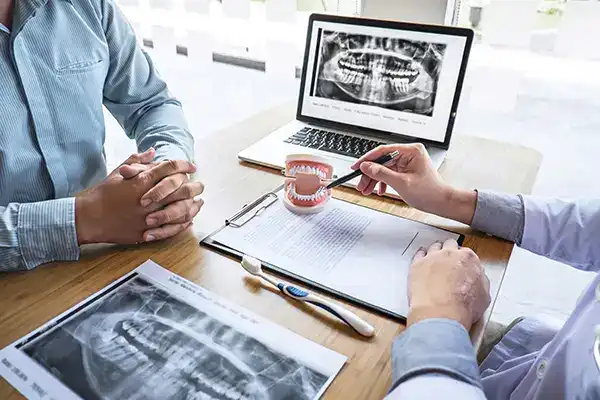 A full mouth reconstruction in Roanoke, VA is what Mountain State Oral and Facial Surgery plans when the problem isn’t one tooth: a staged sequence that rebuilds function across the entire mouth using surgery, implants, and restorative work in whatever combination your case actually needs. Most people who need one didn’t arrive here through a single event. It accumulates. A cracked molar, a failed crown, years of grinding, a couple of extractions that were never replaced, and eventually a mouth where fixing any one thing doesn’t fix much. A full mouth reconstruction in Roanoke, VA is what Mountain State Oral and Facial Surgery plans when the problem isn’t one tooth: a staged sequence that rebuilds function across the entire mouth using surgery, implants, and restorative work in whatever combination your case actually needs. Most people who need one didn’t arrive here through a single event. It accumulates. A cracked molar, a failed crown, years of grinding, a couple of extractions that were never replaced, and eventually a mouth where fixing any one thing doesn’t fix much.
The word “reconstruction” does a lot of work, so let’s be concrete. It isn’t a procedure. It’s a set of procedures, planned together and ordered so each one sets up the next. Our full mouth reconstruction overview covers the concept across the practice, and nearly every case leans on dental implants somewhere in the middle.
One thing worth saying immediately: we’re an oral surgery practice. We handle the surgical half of a reconstruction, which is the extractions, the grafting, and the implant placement, at our Roanoke office on Franklin Road SW. The crowns, bridges, and dentures that go on top are made and fitted by your own dentist. Two providers, one plan, and we’ll tell you plainly which parts are ours.
On This Page
What a Full Mouth Reconstruction Actually Is
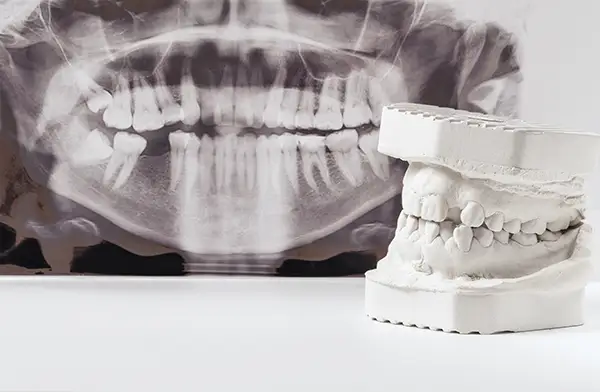 A reconstruction is a sequence, not a service. That distinction changes what you should be asking for: not a price on a procedure, but a plan that puts the procedures in the right order. A reconstruction is a sequence, not a service. That distinction changes what you should be asking for: not a price on a procedure, but a plan that puts the procedures in the right order.
Function comes first and appearance follows from it. That ordering isn’t a philosophy, it’s a constraint. You can’t make teeth look right on a foundation that won’t hold them. Bone gets rebuilt before implants go in, implants integrate before anything gets loaded, and the final teeth are designed around a bite that works. Skip the order and the result fails on a schedule.
Who Needs One?
The cases we see in Roanoke fall into a few patterns. Severe wear, usually from years of grinding, where the teeth have shortened enough that the bite has collapsed. Multiple failing restorations, where crowns and bridges placed across decades start giving out around the same time. Extensive decay that has passed the point where individual fillings make sense. Trauma. And long-term tooth loss, where teeth came out years ago, never got replaced, and the bone has receded since.
The common thread is that treating one problem in isolation doesn’t hold. If you’ve had the same tooth worked on three times, or if your dentist has started using the phrase “we could keep patching this,” that’s the signal.
The Pieces It Might Include
Every plan is different, but the surgical menu is finite. Tooth extraction in Roanoke removes what can’t be saved, which is usually one of the first decisions rather than the last. Bone grafting in Roanoke rebuilds the ridge where it has resorbed, and it comes up more often than patients expect, because bone shrinks once the tooth it supported is gone.
For full-arch cases the options narrow. All-on-4 dental implants in Roanoke support a fixed arch on four implants, two of them angled to reach solid bone that would otherwise need grafting. Same Day Smile in Roanoke puts a fixed provisional arch in place at the surgical appointment. Implant-supported dentures in Roanoke anchor a removable denture to implants, for patients who want implant stability but prefer a prosthesis they can take out.
If your case turns out narrower than a reconstruction, and plenty do, the rest of our oral surgery services in Roanoke cover the individual procedures.
Your Surgical Team in Roanoke
Our surgeons include board-certified oral and maxillofacial surgeons, several of them certified by the American Board of Oral and Maxillofacial Surgery. The current roster is on Meet Our Doctors.
What matters more for a reconstruction is range. A full mouth case can involve extractions, socket preservation, sinus work, ridge grafting, and implant placement inside one plan, and all of it belongs to oral and maxillofacial surgery. Our surgeons handle that full scope across our offices in West Virginia, Kentucky, and Virginia, so the surgical half of your plan doesn’t get split across three separate referrals.
Your restoring dentist is the other half of the team, and we mean that literally. We build the surgical phases around the restoration they intend to deliver rather than the reverse, because the final teeth are what determine where the implants have to go. If your dentist hasn’t worked with us before, our For Doctors section covers how the handoff runs in both directions.
The Phases and Who Handles Each
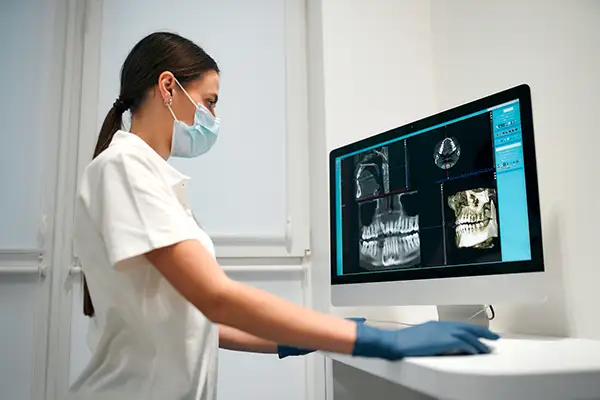 Months, not weeks. A reconstruction runs on biology, and bone heals at its own pace no matter how motivated everyone is. Months, not weeks. A reconstruction runs on biology, and bone heals at its own pace no matter how motivated everyone is.
- Records and planning – a 3D Cone Beam scan and a Trios 5 digital scan at the Franklin Road office map your bone volume, nerve position, and sinus anatomy. We build the surgical plan with your restoring dentist so the implants land where the final teeth will need them.
- Extractions and site preparation – whatever can’t be saved comes out, and we preserve the socket at the same appointment when the site will hold an implant later. Doing both at once saves you an entire healing cycle.
- Grafting – where the ridge has already resorbed, we rebuild it and then wait. Graft maturation usually runs three to six months, and there is no shortcut here worth taking.
- Implant placement – the implants go in and integrate with the bone over roughly three to six months. Some full-arch cases carry a fixed provisional arch through that stretch so you are not without teeth.
- Restoration – your dentist designs and delivers the final teeth. We stay involved through the handoff and see you for the implant follow-ups, but the crowns, bridges, and dentures are theirs to make and fit.
Start to finish, most reconstructions land somewhere between nine months and two years. The variable is almost always grafting: cases that need it add a healing cycle, and cases that don’t move considerably faster. Our post-operative implant instructions walk through what each healing phase actually feels like.
The surgical visits are the ones people worry about, and they’re the ones where you get a choice. Nitrous oxide, oral sedation, and IV sedation are all on the table depending on the visit and on you, and our sedation options explain what each level actually feels like and which ones mean you need a ride home. The follow-up checks need none of it.
Benefits of Rebuilding the Whole Mouth
The first benefit is the one nobody advertises: you stop making decisions one emergency at a time. Patients arrive at a reconstruction after years of reacting, and the change they mention first is having a plan with an end date on it. We put that plan together at the first Roanoke consultation, and it tells you what happens, in what order, and roughly when.
Chewing is the functional payoff. A collapsed or patched-together bite spreads force badly, which is why failures cluster: one restoration goes, the load shifts, the next one goes. Rebuilding the arch resets the loading instead of chasing it, and that’s the reason we would rather plan the whole sequence up front than quote you the next procedure in line.
Bone gets preserved instead of lost. Every year a gap sits empty the ridge underneath it resorbs, and the options narrow as it goes. Dental implants load the bone and slow that down. It’s the argument our surgeons make most often when a patient asks whether this can wait five years.
Appearance changes as a consequence of all that. We plan for function and let the rest follow, and the restorative work your own dentist delivers is where the aesthetics actually get built. We’re not the practice designing your smile. We’re the one making sure there’s something solid underneath it.
Why Choose Our Surgeons for a Reconstruction
The surgical half stays in one place. Extractions, grafting, sinus work, and implant placement all happen at Franklin Road with the same surgeons, which means nobody is coordinating four referrals and hoping the timing lines up.
We plan with your dentist rather than at them. In practice that means the restorative plan comes first and the surgery gets built around it. It’s a slower conversation up front, and it prevents the specific failure where implants end up in bone that was convenient rather than in the position the final teeth needed. X-Guide dynamic 3D navigation is how we hold to that plan in the chair, tracking the drill against the scan as we go.
We’re also plain about the ceiling. We don’t make crowns, we don’t make dentures, and we don’t do cosmetic dentistry. What we do is the surgery underneath all of it, across our offices in West Virginia, Kentucky, and Virginia, and Roanoke patients get the same surgeons as everywhere else.
Full Mouth Reconstruction Cost and Insurance
Cost is the reason most reconstructions get delayed, so we’ll be straight about how it works. There’s no single number, because there’s no single procedure. What you pay depends on how many teeth come out, whether the ridge needs grafting, how many implants go in, and which restorative approach your dentist recommends on top of them.
The billing is split, and that catches people out. We bill the surgical phases. Your restoring dentist bills the restorative phases separately. Two providers, two sets of paperwork, and a total that arrives in pieces rather than as one quote, which is exactly why we’d rather map the whole sequence at the first appointment than hand you the next procedure in isolation.
Insurance usually covers part of it. Extractions and some grafting often qualify under dental benefits, and because plans reset annually, a sequence spread across two calendar years sometimes recovers more than a compressed one. Our financial and insurance information covers the plans we work with and the payment options available. Call our Roanoke office at (540) 283-4940 and we can sequence treatment around your benefits where that makes clinical sense.
Start Your Full Mouth Reconstruction Consultation
Bring whatever you have: old X-rays, a treatment plan from another office, or just a list of what hurts. Call our Roanoke office at (540) 283-4940 or request an appointment online. We’re at 1603 Franklin Rd SW, Roanoke, VA 24016. Our hours are Monday through Thursday from 8:00 AM to 4:00 PM, and Friday until 2:30 PM.
Frequently Asked Questions
Where do I start if I am not sure what I need?
With a scan and a conversation. Most people arrive knowing something is wrong without knowing what the plan should be, and that’s normal. The Cone Beam scan shows bone volume, the condition of the roots, and what’s salvageable, which is what turns a vague problem into a sequence. Bring any records you have from other offices. You’ll leave knowing whether this is a reconstruction or something smaller.
Do you make the crowns and dentures too?
No. We’re oral and maxillofacial surgeons, so we handle the extractions, the grafting, and the implants. Your general dentist or prosthodontist designs and delivers the crowns, bridges, and dentures that attach to what we place. If you don’t have a restoring dentist yet, we’ll help you find one, because the plan needs both halves before we start the first one.
Do I have to lose all my teeth?
Usually not. A reconstruction isn’t automatically a full-arch case, and healthy teeth with sound bone around them are worth keeping. The ones that come out are the ones that won’t survive the plan: fractured roots, failed root canals, advanced periodontal loss. We’d rather build around what you have than clear the deck for convenience, and the scan tells us which is which.
Why not just get dentures?
Some people should, and we’ll say so. A conventional denture is the least invasive option and the fastest to deliver. What it doesn’t do is load the bone underneath it, which is why dentures loosen over the years and need relining. Implant-supported dentures in Roanoke sit in the middle: still removable, but anchored to implants. The right answer depends on your bone, your health, and what you want to be able to eat.
Is a full mouth reconstruction the same as a smile makeover?
No, and the difference decides who you should be calling. A smile makeover is cosmetic dentistry: veneers, whitening, bonding on teeth that are basically healthy underneath. A reconstruction is what happens when function has failed and the mouth needs rebuilding from the bone up. Cosmetic work sits on a sound foundation. Reconstruction builds the foundation. If everything underneath is fine and you want the appearance changed, you want a cosmetic dentist rather than a surgeon.
Will insurance cover any of it?
Some of it, usually. Dental plans typically pay toward extractions and part of the implant work up to your annual maximum, which a full reconstruction will use up quickly. Certain surgical phases cross over to medical coverage depending on the diagnosis, and that’s worth checking rather than assuming. Ask for a pre-treatment estimate before you start: it takes a couple of weeks and it converts guesswork into a number. Our insurance and financing options list the plans we work with.
What if I can only do part of it right now?
That’s a normal way to do this. A reconstruction is staged anyway, so the real question is which stages go first, and the answer is usually the ones that stop things getting worse: removing teeth that are infected, preserving sockets so the ridge doesn’t collapse, grafting where bone is already thinning. Those buy you time without closing off options. What we’d rather you not do is start restorative work on a foundation that isn’t finished.
How do I know if I need bone grafting?
A standard dental X-ray can’t tell you, which is the honest answer. It’s a flat image, and ridge width is what decides the question. Whether you need bone grafting in Roanoke gets settled by the Cone Beam scan, which shows the ridge in three dimensions. As a rule of thumb, the longer a tooth has been missing the more likely it becomes, since most of the width is lost within the first year after an extraction.
|