Full Mouth Reconstruction Lynchburg, VA
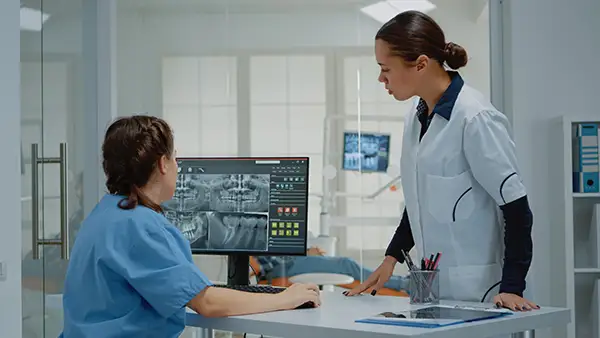 Full mouth reconstruction in Lynchburg, VA is a year or more of planned work, and Mountain State Oral and Facial Surgery handles the surgical side of it: the extractions, the bone grafting, and the implants that everything else attaches to. The restorative half, meaning the crowns, bridges, and dentures, belongs to your own dentist. We say that first because it’s the question patients ask third and should ask first. Full mouth reconstruction in Lynchburg, VA is a year or more of planned work, and Mountain State Oral and Facial Surgery handles the surgical side of it: the extractions, the bone grafting, and the implants that everything else attaches to. The restorative half, meaning the crowns, bridges, and dentures, belongs to your own dentist. We say that first because it’s the question patients ask third and should ask first.
Nobody plans for this. What happens instead is a slow accumulation. A tooth breaks, a crown fails, another tooth gets pulled and never replaced, and the bite quietly redistributes itself onto whatever is left. Ten years of that and the individual repairs stop holding, because the problem was never the individual teeth. Our full mouth reconstruction overview covers the concept across the practice, and most plans lean on dental implants to carry the load.
Everything on our side happens at the Lynchburg office on Graves Mill Road, Monday through Friday from 8:00 AM to 5:00 PM. That matters here more than it would for a single procedure. A reconstruction isn’t one appointment you steel yourself for. It’s a dozen or more spread across a year, and the ones that take twenty minutes shouldn’t cost you half a day.
On This Page
Rebuilding a Mouth, Not Repairing a Tooth
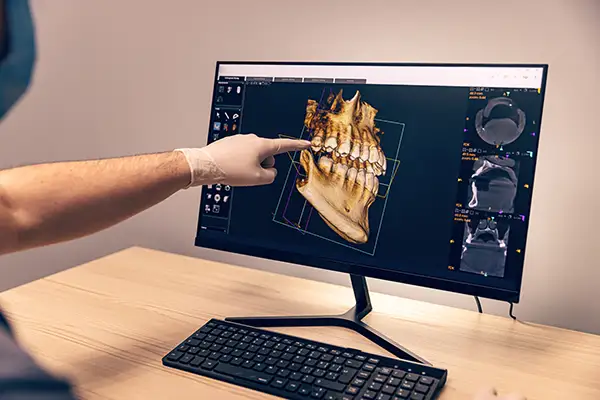 The defining feature of a reconstruction is that the pieces depend on each other. You can replace a single missing molar without thinking hard about the rest of the mouth. You can’t rebuild an entire arch that way, because where one implant goes changes what’s possible three teeth over, and the bite has to work as a whole or it doesn’t work at all. The defining feature of a reconstruction is that the pieces depend on each other. You can replace a single missing molar without thinking hard about the rest of the mouth. You can’t rebuild an entire arch that way, because where one implant goes changes what’s possible three teeth over, and the bite has to work as a whole or it doesn’t work at all.
That’s why the plan comes before the treatment, and why the plan is worth more than any single procedure inside it. We map the whole thing at the front end: what comes out, what gets grafted, where the implants go, what your dentist puts on top, and in what order. Then we follow it. Changing the order mid-sequence is how reconstructions go sideways.
When Patching Stops Working
There’s usually a moment. A crown comes off for the third time. A tooth that was crowned five years ago fractures at the root. The partial denture stops fitting because the teeth it clasps onto have shifted. Any one of those on its own is a repair. Together, and repeating, they mean the foundation is the problem.
The patterns we see in Lynchburg run to a short list: years of grinding that shortened the teeth and collapsed the bite, restorations from the 1990s all reaching the end together, decay that outran the fillings, and old extractions that were never replaced while the bone underneath quietly disappeared.
What Your Plan Might Involve
The surgical components are the same handful in most plans, combined differently. Tooth extraction in Lynchburg clears what can’t be kept. Bone grafting in Lynchburg rebuilds a ridge that has thinned, which is common in exactly the cases that need reconstruction, since the bone has usually gone unloaded for years.
When an entire arch is failing, three approaches cover most of it. All-on-4 dental implants in Lynchburg carry a fixed arch on four implants, angled to use the bone you still have. Same Day Smile in Lynchburg delivers a fixed temporary arch the day of surgery. Implant-supported dentures in Lynchburg clip onto implants and come out for cleaning.
Not every case is this big. If yours turns out smaller, the rest of our oral surgery services in Lynchburg cover the individual procedures on their own.
Your Surgical Team in Lynchburg
A reconstruction asks one surgeon to be good at several different operations. Extractions, socket preservation, ridge augmentation, sinus lifts, and implant placement all sit inside oral and maxillofacial surgery, and our surgeons include board-certified oral and maxillofacial surgeons, several of them certified by the American Board of Oral and Maxillofacial Surgery. Meet Our Doctors has the current roster.
The Graves Mill Road office runs on the same surgical team as the rest of our practice across West Virginia, Kentucky, and Virginia. Same surgeons, same planning process, same imaging you would get at any of our offices.
Your restoring dentist is the other half. We’re deliberate about that relationship, because in a reconstruction the restoration dictates the surgery. Where your dentist wants the final teeth is where the implants have to go, which means their plan has to exist before ours does.
What a Year of Treatment Actually Looks Like
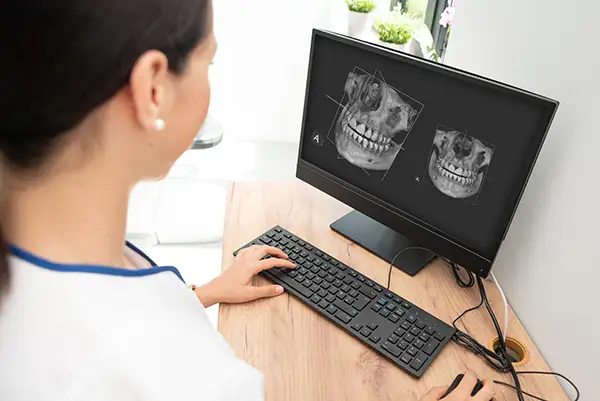 Nine months to two years, and more appointments than you expect. Most are short, a few are not, and the long gaps in between are bone healing rather than scheduling problems. Nine months to two years, and more appointments than you expect. Most are short, a few are not, and the long gaps in between are bone healing rather than scheduling problems.
- Consultation and records – one visit, about an hour. A 3D Cone Beam scan and a Trios 5 digital scan at Graves Mill Road give us bone volume, root condition, nerve position, and sinus anatomy in a single model.
- Planning – we work the plan through with your dentist, then walk you through it. You see the whole sequence before you commit to the first step of it.
- Extractions and site preparation – usually one appointment, sometimes two if the case is split by arch. We preserve the sockets at the same visit wherever an implant is coming later.
- Grafting and healing – if the ridge needs it, we graft and then wait three to six months. This is the longest gap in the plan, and nothing compresses it.
- Implant placement and integration – another surgical visit, then three to six months while the bone locks onto the implants. The checks through this phase are brief.
- Handoff to your dentist – your dentist takes over for the final teeth. We stay in the loop and keep seeing you for implant checks, but the crowns, bridges, and dentures are theirs to design, make, and fit.
The question we get most is what recovery feels like when there are several surgical visits instead of one. We use Exparel, a long-acting local analgesic that keeps a surgical site numb well past the day of the procedure, and it’s approved for patients as young as six. On a single extraction that’s a convenience. Across a reconstruction, where you may face two or three separate surgical appointments in a year, it changes the shape of the whole plan. Our anesthesia options cover the full range, from local through general.
The honest version is that a reconstruction isn’t painless, and we won’t tell you otherwise. It’s a series of real operations. What we can tell you is that the difficult part is front-loaded into a few days after each surgical visit, that most of the calendar is waiting rather than hurting, and that the post-operative implant instructions we send home cover what each phase actually feels like.
Benefits of Rebuilding the Foundation
Your mouth stops being a running cost. That’s the benefit patients rarely lead with and usually end up naming. A failing dentition bills you every year, in emergencies, in re-dos, in the crown that lasted four years instead of fifteen. A finished reconstruction converts that into a known quantity, which is why we map the entire sequence at the first Graves Mill Road appointment rather than handing it to you in pieces.
Eating comes back, and it comes back in a specific way worth being clear about. Implant-supported teeth transmit force through bone rather than resting on gum, so bite strength lands much closer to natural teeth than a conventional denture manages. Steak is realistic again for most patients. What your final teeth can handle is something we settle with your dentist before the implants go in, not after.
Dental implants don’t decay, which surprises people. The implant is titanium and the crown on it is ceramic, so neither one gets a cavity. What can still fail is the tissue around them, and peri-implantitis is why we’re insistent about hygiene and the follow-up checks at Graves Mill Road rather than relaxed about them. A reconstruction trades a decay problem for a gum-health problem, which is a much better problem to have.
Appearance improves, and we want to be accurate about whose work that is. The bone and the implant position set what’s possible. Your dentist decides what it looks like. We build the platform, the aesthetics get designed and delivered on the restorative side, and a good result needs both halves done well.
Why Lynchburg Patients Choose Our Surgeons
The whole surgical sequence runs out of one building. Extractions, socket preservation, grafting, sinus work, and implant placement all happen at Graves Mill Road with the same surgeons across the year. In a treatment this long, continuity isn’t a nicety: the person placing the implants is the person who took the teeth out and knows what the bone did afterward. They also work from the same X-Guide dynamic 3D navigation that put each implant where the plan said it should go.
Recovery gets designed rather than defaulted. Because a reconstruction stacks several surgical visits, we plan the anesthesia and the pain control for each one, Exparel included, instead of treating them as identical events.
And we stay inside our lane. We don’t make crowns, we don’t make dentures, and we don’t design smiles. What we do is the surgery underneath all of it, and we’d rather tell you where our part ends than let you find out in month eight.
Full Mouth Reconstruction Cost and Payment
Two invoices, not one. That’s the first thing to understand about paying for a reconstruction, and it’s what a single-number quote hides. We bill our surgical phases. Your restoring dentist bills the restorative phases on their own schedule. Anyone quoting one figure for the whole thing is either guessing or leaving something out.
On our side, the number moves with how many teeth come out, whether the ridge needs grafting, how many implants go in, and whether the case is one arch or both. There’s no useful average to give you, because the distance between a straightforward case and a complicated one is enormous.
The staging works in your favor here. A reconstruction happens across months regardless, so the cost arrives across months too, and dental benefits reset each year. Our financial and insurance information covers the plans we work with and the payment arrangements available. Call the Lynchburg office at (434) 316-7111 once you have a diagnosis, and we can put real numbers against your actual plan.
Book Your Reconstruction Consultation in Lynchburg
The first visit is a scan and an honest assessment, nothing more. Call our Lynchburg office at (434) 316-7111 or request an appointment online. We’re at 1612 Graves Mill Road, Lynchburg, VA 24502. The office is open Monday through Friday from 8:00 AM to 5:00 PM.
Frequently Asked Questions
Will I be without teeth at any point?
Usually not, though it depends on the plan. Full-arch cases can often carry a fixed provisional arch from the day of surgery, which is what Same Day Smile in Lynchburg describes. Partial cases usually keep enough teeth that the gaps aren’t visible, or bridge them with a temporary. The honest exception is a stretch during grafting where a removable temporary is the only option. Ask about it at the consultation, because it can change which sequence we recommend.
How many separate surgeries is this?
Usually two or three, not one and not ten. The common shape is one appointment for extractions and socket preservation, one for grafting if you need it, and one for implant placement. A case that only needs grafting in one small area can sometimes combine two of those. Splitting by arch adds a visit. Everything else on the calendar is a check, and those are short.
Will I need opioid painkillers?
Most patients don’t, and that’s deliberate rather than accidental. Exparel covers the first stretch after surgery, and past that, most people do well on ibuprofen and acetaminophen taken together on a schedule, which works better for dental surgery than either one alone. Some cases still warrant a short opioid course and we prescribe one when they do. What we don’t do is default to it. Our anesthesia options cover what we use and when.
Can it all be done in one visit?
No, and be careful with anyone who suggests otherwise. Bone integration takes months and no technology changes that. What can be compressed is the visible part: a full-arch case can have teeth in place the same day the implants go in, so you walk out with a smile while integration happens underneath. That’s a provisional, not the finished restoration, and the distinction gets blurred in advertising more often than it should.
What happens if an implant fails?
We remove it, work out why, and usually place another once the site heals. Implant failure is uncommon but it isn’t zero, and the honest risk factors are smoking, uncontrolled diabetes, and inadequate bone at the time of placement. Two of those we can screen for before we start. The first one is yours to manage, and we’ll be direct with you about it if it applies to you.
How long will the finished work last?
Implants themselves routinely last decades when the bone and gum around them stay healthy. The restorations on top have a shorter working life, because a crown or a bridge is a wearing part and your dentist will expect to repair or replace one eventually. Nobody can give you a guaranteed number, and you should be skeptical of anyone who tries. Hygiene and keeping your follow-ups predict longevity better than anything we do in surgery.
Am I too old for this?
Age by itself doesn’t rule anyone out. Healing capacity tracks general health far more closely than birth year, so the real questions are whether your bone will accept an implant and whether you can tolerate the surgical visits. Uncontrolled diabetes, active smoking, and certain bone-density medications weigh more heavily than being 75. We work that out from your medical history and the scan.
I am a general dentist. How does co-treatment work with your office?
You keep the case. We handle the surgical phases and send it back. In practice we want your restorative plan before we plan the surgery, since implant position is dictated by where the final teeth are going. You get the scan, the surgical plan, and the timeline, and the patient stays in your chair for everything that isn’t ours. Our For Doctors section has the referral details, and the Lynchburg office line is (434) 316-7111.
|